
Search “POSH compliance checklist” and you will find dozens of near-identical articles listing the same nine steps. What almost nobody publishes is a genuine answer to the question that actually determines whether your compliance holds up: how do you tell a real POSH compliance partner from a template seller with a website?
Moreover, this decision carries more weight than most HR teams realize when they’re making it. A poorly vetted partner does not just waste a budget line. It can leave an Internal Committee’s legitimacy exposed at exactly the moment a real complaint arrives.
What You’ll Learn in This Guide
This article covers:
- Why the market’s generic checklist content doesn’t help you choose a partner
- Seven criteria that should actually carry weight in your evaluation
- Specific red flags worth walking away from
- Questions to put in writing before you sign anything
- What investors and acquirers now check for during due diligence
Why Choosing a POSH Compliance Partner Actually Matters
Every organization eventually faces the same choice: build POSH Act, 2013 compliance entirely in-house, or bring in outside expertise for policy drafting, committee training, and ongoing support. Most mid-sized and growing companies choose the second path, since few HR teams have deep POSH litigation experience on staff. Therefore, the partner you choose effectively becomes your organization’s compliance judgment for everything that follows.
The Market Is Full of Generic Checklists, Not Real Partners
Search results for POSH compliance are dominated by content that reads almost interchangeably: form a committee, write a policy, run training, file a report. This content isn’t wrong. It’s just not useful for the actual decision you’re trying to make. Consequently, evaluating vendors on the same generic checklist they all publish tells you nothing about how they’ll actually perform when a real case lands on their desk.
Seven Criteria That Should Carry Real Weight
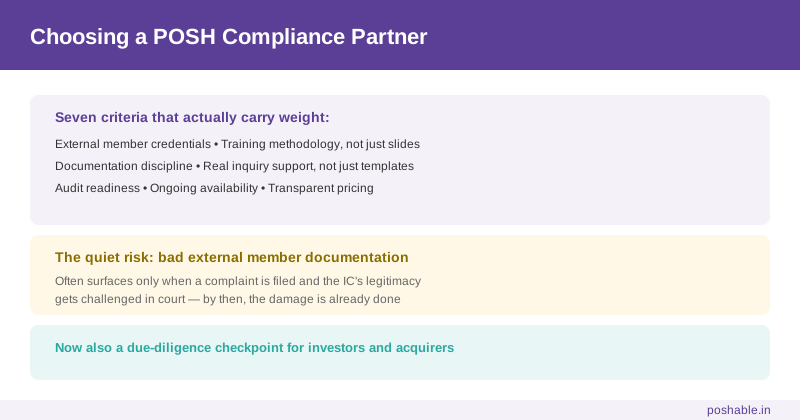
- External member credentials: real, documented expertise, not a name filled in to satisfy a form
- Training methodology: interactive, scenario-based sessions, not a slide deck read aloud once a year
- Documentation discipline: dated policies, tracked committee terms, and audit-ready records from day one
- Real inquiry support: guidance while a live case is actually running, not just templates handed over upfront
- Audit readiness: a partner who prepares you for scrutiny, not one who only reacts to it
- Ongoing availability: someone reachable mid-case, not only during the annual renewal call
- Transparent pricing: a clear scope, not a quote that grows once you’re already committed
POSH Compliance Partner Red Flags Worth Walking Away From
Some warning signs are easy to spot once you know to look for them. A vendor who cannot name their actual external member roster. A training program with no measurable content beyond a generic PDF. A policy template identical to three other companies you’ve seen. Moreover, any partner who cannot clearly explain how they would handle documentation if your Internal Committee’s composition were challenged should raise real concern, not just curiosity.
Questions to Put in Writing Before You Sign Anything
- Who exactly serves as our external committee member, and what is their specific background?
- What happens, step by step, if a complaint is filed the week after onboarding finishes?
- How do you keep our annual reporting and documentation current after the initial setup?
- What does ongoing training actually look like beyond the first session?
Why External Member Documentation Quietly Decides Cases
This is the risk most companies never think about until it’s too late. A committee’s entire inquiry can be challenged on composition grounds alone, and this often surfaces only once a complaint is already filed, when reversing course is expensive and disruptive. Therefore, verifying this specific piece before you sign, not after, is one of the highest-leverage checks in this whole process.
What Investors and Acquirers Actually Check For
POSH compliance has quietly become a real line item in investor and acquirer due diligence. A company that cannot produce a properly documented committee, a current policy, and clean training records raises exactly the kind of governance flag that slows down or derails a deal. Consequently, treating your compliance partner as a strategic choice, not just an HR vendor, reflects how seriously the market now treats this.
POSH Compliance Partner vs. a Generic Legal Retainer
A general corporate lawyer can draft a policy competently. What they typically cannot offer is ongoing committee training, ready external member support, and the operational rhythm a functioning POSH program actually needs. Therefore, the right comparison isn’t “lawyer versus consultant.” It’s whether the partner treats compliance as a continuous program or a one-time deliverable.
A Practical Scorecard You Can Actually Use
Before your next vendor call, score each candidate honestly against the seven criteria above, on a simple scale from one to five. A partner who cannot answer clearly enough for you to score them at all has already told you something important.
What to Expect From a Genuinely Good Partner
A strong partner explains their process before you ask, names their external members without hesitation, and treats your audit readiness as an ongoing responsibility rather than a one-time delivery. If a vendor seems reluctant to get specific about any of this, that reluctance is itself useful information.
Conclusion: The Right POSH Compliance Partner Is a Decision, Not a Purchase
In conclusion, choosing a POSH compliance partner deserves the same scrutiny as any decision that carries real legal and reputational weight, because that’s exactly what it is. Moreover, the questions in this guide exist precisely because so few vendors get asked them directly. If you’d like to see how our own approach holds up against this exact scorecard, our team is genuinely happy to walk through it with you, criterion by criterion, before you decide anything.