
Ask any HR team whether they meet POSH training requirements, and most will say yes without hesitation. Ask them when the last session actually happened, or whether anyone measured whether it changed anything, and the confidence usually drops fast.
Moreover, 2025 made this gap harder to ignore. The Supreme Court itself ordered a nationwide compliance check, and training sat right at the center of what it wanted verified. Therefore, understanding what the law actually expects, not just what feels sufficient, matters more now than it did a year ago.
Request a demo today to see how our POSH compliance solutions can help your organization stay compliant and build a safer workplace.
What You’ll Learn in This Guide
This article covers:
- What Section 19 actually requires around training
- How often sessions should realistically happen
- What separates a genuinely useful session from a checkbox exercise
- A 2025 Supreme Court push that raised the stakes nationwide
- What inadequate training actually costs an organization
POSH Training Requirements: What Section 19 Actually Says
Under Section 19(c) of the POSH Act, 2013, employers must organize workshops and awareness programs at regular intervals, and provide orientation for Internal Committee members. Notably, the Act does not fix an exact frequency. It simply demands that training genuinely happens, and that it happens on an ongoing basis, not once.
How Often Training Should Actually Happen
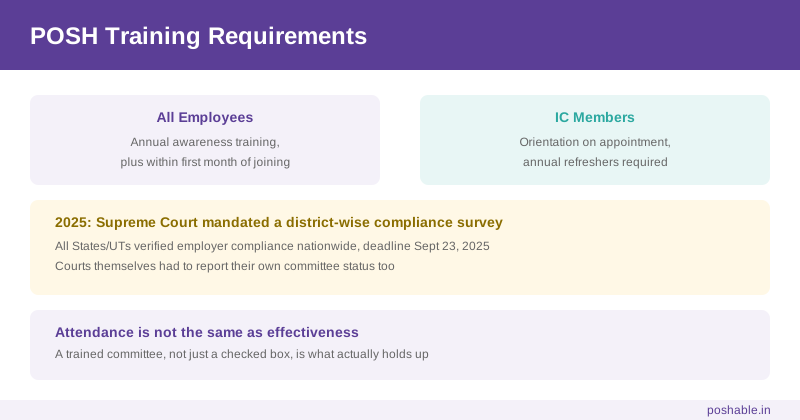
Widely accepted practice, backed by what district officers and courts increasingly expect, looks like this: annual awareness training for every employee, and training within the first month for new joiners. Internal Committee members specifically need yearly refreshers on top of that. Moreover, any time a new member joins the committee, that person needs orientation before handling a live case, not after.
What Belongs in a Genuinely Compliant Session
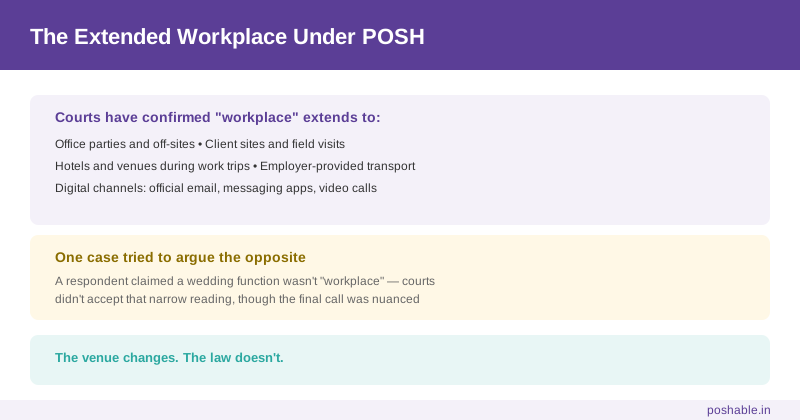
Good training covers the Act’s expanded definition of “workplace” and uses realistic scenarios instead of abstract legal language. It also walks through reporting channels, confidentiality, and anti-retaliation protections clearly. It should also draw role-specific lines. An ordinary employee needs to know what to do. A manager has separate obligations to understand. The Internal Committee itself handles a different set of responsibilities entirely.
POSH Training Requirements for Internal Committee Members Specifically
IC members carry responsibilities close to a quasi-judicial role, and most of them are employees without any formal legal background. Consequently, their training needs to go well beyond a general awareness session. It should cover natural justice principles, evidence handling, statutory timelines, and how to properly document an inquiry from start to finish.
Why Attendance Alone Doesn’t Mean the Training Worked
Employees can sit through the same session every year while the same patterns of inappropriate behavior keep surfacing on the same teams. This tells you something important: the problem usually isn’t that training is missing entirely. It’s that a lecture-style, one-way session rarely shifts actual behavior on its own.
A 2025 Supreme Court Push That Changes the Stakes
In 2025, the Supreme Court ordered all States and Union Territories to complete a district-wise compliance survey. It verified whether employers had properly constituted Internal Committees, adopted policies, and implemented awareness measures, with a deadline of September 23, 2025. Even more strikingly, the Court required High Courts and subordinate judicial bodies to report on their own committees too. This held the judiciary to the same standard it expects of everyone else.
As a result, “we ran a session once” is no longer a comfortable answer if a regulator or court actually asks to see proof.
What Inadequate IC Training Actually Costs an Organization
A poorly trained committee risks flawed inquiries, missed statutory timelines, and findings vulnerable to challenge later. Moreover, this exposes both the organization and individual committee members, who can face removal for failing to discharge their duties properly. Therefore, treating IC training as optional is a false economy that surfaces at exactly the wrong moment, during a real complaint.
POSH Training Requirements: A Practical Checklist
- Schedule annual awareness training for all employees, with onboarding coverage for new joiners
- Provide IC member orientation immediately upon appointment, not at the next convenient date
- Keep attendance records, training outlines, and completion certificates on file
- Use realistic scenarios and role-specific content instead of generic legal slides
- Review whether training content still matches current law after any regulatory update
Common Mistakes That Turn Training Into a Checkbox Exercise
- Treating one annual session as sufficient for both employees and IC members alike
- Skipping documentation, leaving no proof training actually occurred
- Using generic content that never mentions the organization’s actual reporting channels
- Letting IC members handle a case before they’ve received any real orientation
Request a demo today to see how our POSH compliance solutions can help your organization stay compliant and build a safer workplace.
POSH Compliance Services for Structured Training Programs
Many organizations bring in POSH compliance services specifically to design training that goes beyond a slide deck: realistic scenarios, role-specific tracks, and proper documentation built in from the start. This is exactly the kind of preparation a POSH audit looks for.
Conclusion: POSH Training Requirements Are About Capability, Not Attendance
In conclusion, POSH training requirements exist to build genuine capability, not just to fill an attendance sheet. Moreover, the Supreme Court’s 2025 nationwide compliance push shows regulators are now actively checking whether that capability is real. Therefore, organizations that treat training as an ongoing investment, not a once-a-year formality, are the ones genuinely prepared when a complaint actually arrives.
Request a demo today and discover how our expert-led POSH compliance services can help your organization stay compliant, reduce risk, and build a safer workplace.