
“We already have a global anti-harassment policy” is one of the most common, and most mistaken, assumptions a foreign company makes when setting up in India. POSH for multinational companies doesn’t work that way, and the gap between assumption and requirement tends to surface at exactly the wrong moment.
Moreover, India’s Global Capability Centre boom has made this question more urgent, not less. Thousands of multinational finance, technology, and shared-services operations now employ Indian staff directly, and every one of them answers to Indian law on this point, regardless of where headquarters sits.
What You’ll Learn in This Guide
This article covers:
- Why a global HR policy alone doesn’t satisfy Indian requirements
- The threshold that applies no matter where a company is headquartered
- What GCCs specifically need to get right
- How outsourcing and contractor relationships still carry real risk
- What to ask before setting up a new India entity
POSH for Multinational Companies: Why “We Have a Global Policy” Isn’t an Answer
A UK, US, or Singapore head office’s group-wide grievance system does not remove the need for local Indian compliance. The POSH Act, 2013 applies to every workplace situated in India, regardless of whether the employer is an Indian entity, a foreign company, or a multinational subsidiary.
The Threshold That Applies Regardless of Where Headquarters Sits
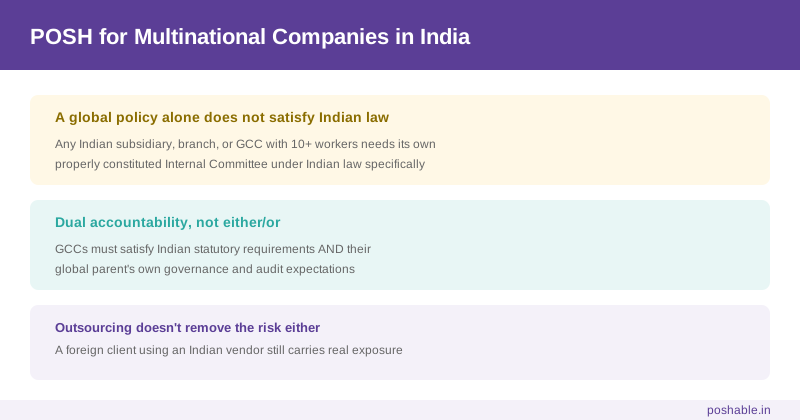
Any Indian subsidiary, branch office, or captive service centre with ten or more workers should assume it needs its own Internal Committee. This committee has to be properly constituted under Indian law specifically. It cannot simply be nominated under a global policy framework written for an entirely different jurisdiction.
What a Global Anti-Harassment Policy Actually Misses
Global policies typically lack India-specific procedural requirements. These include the exact committee composition Indian law demands, statutory inquiry timelines, mandatory annual reporting to a District Officer, and confidentiality obligations that carry their own penalty structure locally. Consequently, a well-intentioned global document usually needs a genuine India-specific companion, not a translation of the same text.
POSH for Multinational Companies: The GCC Boom Changed the Stakes
India remains one of the most important hubs globally for Global Capability Centres, and technology, analytics, and finance operations have expanded rapidly here. Consequently, compliance for these centres has moved well beyond a standard HR checklist item. It now sits inside core legal risk management and governance planning from the very first day of setup.
Dual Accountability: Satisfying Indian Law and a Global Parent at Once
A GCC’s compliance function typically has to satisfy two audiences simultaneously. These are Indian statutory requirements, and a global parent whose own regulators or auditors may review practices from an entirely different jurisdiction. Therefore, compliance architecture, not just general awareness of the law, becomes the real priority for organizations operating at this scale.
Outsourcing and Contractor Risk Doesn’t Disappear Either
Where a foreign company uses Indian subcontractors, outsourcing partners, or call centres, the Indian vendor remains responsible for its own POSH compliance. However, the foreign client shouldn’t treat this as someone else’s problem entirely. Reputational and cross-organizational risk still flows back to whoever’s brand sits on the contract.
Common Mistakes Foreign Employers Make in India
- Assuming a global code of conduct satisfies India’s specific statutory requirements
- Appointing an Internal Committee without the mandatory external member
- Treating the annual reporting obligation as optional for a foreign-owned entity
- Never adapting training content to reference actual Indian committee members and channels
POSH for Multinational Companies: Building One Framework That Works Both Ways
The better approach layers India-specific compliance underneath a global policy, rather than treating the two as competing documents. A properly constituted committee, an India-specific written policy, and consistent annual reporting can sit comfortably alongside a global framework. This satisfies both a group audit and a local inspector at the same time.
What to Ask If You’re Setting Up a New India Entity
Confirm exactly when the ten-employee threshold gets triggered, since it often arrives faster than a new entity expects. Identify who will serve as the external committee member early, since sourcing one properly takes real time. Build the annual reporting calendar into the entity’s compliance setup from day one, rather than discovering the deadline after it’s already passed.
Supplier Contracts Should Reflect This Too
Contracts with Indian vendors and outsourcing partners should explicitly require POSH compliance. This includes proper committee constitution, employee training, annual reporting, and cooperation with any investigation. This protects the foreign client just as much as it protects the vendor’s own employees.
Conclusion: POSH for Multinational Companies Means Local Law, Not Just Global Intent
In conclusion, POSH for multinational companies genuinely requires meeting India’s specific statutory framework, not simply extending a global policy’s good intentions across borders. Moreover, as India’s GCC sector keeps growing, this compliance gap becomes a governance question boards actually care about, not just an HR footnote. Therefore, treating Indian POSH compliance as its own genuine workstream, built to sit alongside a global framework rather than replaced by it, is what actually protects both the organization and its people. Request a demo today if your multinational business needs help building compliance that works for both your India operations and your global parent.