
The extended workplace doctrine exists precisely because “that happened at the office party, not at work” is one of the most common defenses raised when a POSH complaint touches something outside the four walls of an actual office. It is also almost never a winning argument, and understanding exactly why matters for both employees and employers.
Moreover, the POSH Act, 2013 was deliberately written to reach far beyond a physical desk, and courts have generally read that language broadly rather than narrowly.
What You’ll Learn in This Guide
This article covers:
- What Section 2(o) actually says about where “workplace” extends
- Why office parties don’t get a pass just because they’re social
- How work trips, client sites, and company transport fit in
- A real case where a respondent tried to argue the opposite
- Where digital spaces fit into this same doctrine
The Extended Workplace: Why “At the Office” Was Never the Real Boundary
The Act never limited itself to a single physical building. Instead, it defines workplace broadly enough to follow the employment relationship itself, into spaces most people wouldn’t instinctively call an office at all.
What Section 2(o) Actually Says About Where “Workplace” Extends
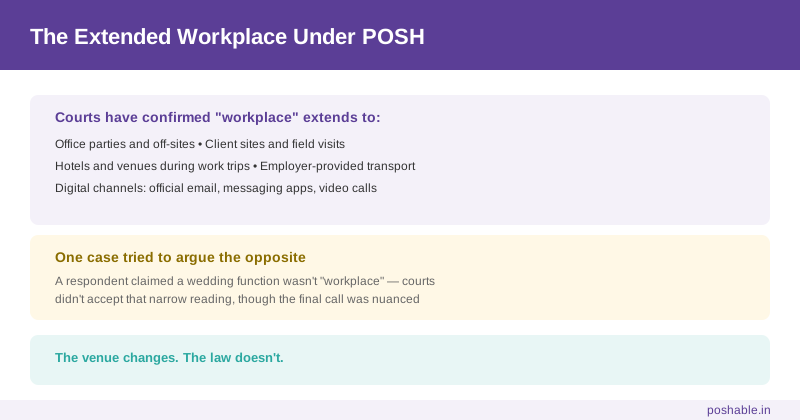
Section 2(o)(v) explicitly includes any place an employee visits arising out of, or during the course of, employment, including transportation the employer provides for that purpose. Consequently, Parliament wrote the statutory language itself to reach beyond a fixed address from the very start.
Office Parties Don’t Get a Pass Just Because They’re “Fun”
A Diwali celebration or an annual offsite does not suspend the Act for its duration. Comments about someone’s appearance, made under the cover of “we were all just having fun,” still fall squarely within scope. The venue changes. The law doesn’t.
The Extended Workplace on Work Trips, Client Sites, and Company Transport
A conference, a client’s office, or a company-arranged cab all count as the workplace for POSH purposes. Conduct in a hotel during a work trip isn’t somehow outside the Act’s reach simply because the incident happened away from home base. Therefore, employees traveling for work carry the same protections traveling as they do sitting at their usual desk.
A Case Where a Respondent Tried to Argue the Opposite
In Silajit Guha v. Sikkim University (2020), a professor faced a harassment complaint over an incident at a wedding function. He argued the venue fell outside the Act’s definition of workplace, leaning on narrower precedent from workmen’s compensation law. The Internal Committee had already found the complaint true and recommended his termination. The Sikkim High Court did not accept his narrow reading outright.
What the Courts Actually Left Unresolved
This case is worth presenting honestly rather than as a clean, tidy precedent. On appeal, the Division Bench partly set aside the single judge’s order. It left the university’s Executive Authority to make the final determination on the specific facts. Therefore, the real lesson here isn’t “courts always rule broadly, full stop.” It’s that a narrow reading rarely succeeds outright, even when resolving a particular case takes more than one round of proceedings.
Digital Spaces Count Too, Not Just Physical Locations
Courts and regulators have also read “workplace” to include official digital channels: work email, messaging apps, video calls, and collaboration tools. Conduct through these channels, during or in connection with work, sits within the Act’s scope. This extends further into how distributed and remote arrangements get treated too, a related question this site covers in more depth elsewhere.
The Extended Workplace and Third-Party Harassment
If a client, vendor, or visitor harasses an employee at a location the extended workplace doctrine covers, the employer’s Section 19 obligations still apply. The employer must still take appropriate steps, regardless of whether the harasser is technically on the payroll.
Practical Checklist for Handling Off-Site Incidents
- Treat a complaint about an offsite event, work trip, or client visit with the same seriousness as one from the main office
- Never dismiss a complaint solely because the incident occurred outside normal office hours or premises
- Confirm whether employer-provided transport or accommodation was involved, since this strengthens the workplace connection
- Document the work-related purpose of the trip or event clearly if jurisdiction is ever challenged
What Employers Should Communicate Clearly to Staff
Employees should understand upfront that POSH protections travel with them, not just their desk. Making this explicit in onboarding and policy documents heads off exactly the confusion that lets harassment at offsite events go unreported in the first place.
Conclusion: The Extended Workplace Doctrine Protects People, Not Places
In conclusion, the extended workplace doctrine exists because harassment doesn’t confine itself to a building, and Parliament wrote the law with that reality in mind. Moreover, even when a respondent pushes back hard on this point, as in the Sikkim University case, courts generally resist an artificially narrow reading. Therefore, both employees and employers benefit from treating “workplace” as a description of the employment relationship, not a physical address. Request a demo today if your organization needs clearer guidance on where your own POSH obligations actually extend.