
Most conversations about POSH disciplinary action jump straight to one question: does the person get fired? However, this framing misses most of what actually happens after an Internal Committee finds a complaint proven. Termination is one option on a real range, not the default outcome.
Moreover, getting this stage wrong carries its own legal risk, separate from getting the inquiry itself wrong. Under the POSH Act, 2013, choosing the right disciplinary action, not just any action, is part of what the law actually expects.
What You’ll Learn in This Guide
This article covers:
- The full range of penalties an Internal Committee can actually recommend
- Why the employer doesn’t get to freely choose the outcome
- The proportionality principle courts actually apply
- What happens when a parallel criminal case reaches a different verdict
- A carve-out most people don’t know exists
POSH Disciplinary Action: It’s Not Just “Fire Them or Don’t”
Section 13 of the Act requires the employer to act on the Internal Committee’s recommendation once an inquiry proves the complaint. This action can take several forms, and termination sits at the far end of a genuine spectrum, not as the automatic default.
The Full Range of Penalties an IC Can Actually Recommend
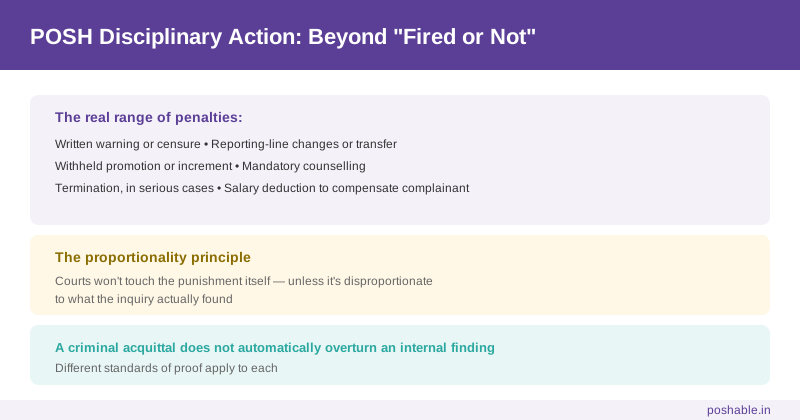
Depending on the severity of what the inquiry found, a committee can recommend a written warning, apology, or formal censure. It can recommend realigning reporting lines or transferring the respondent. Withholding a promotion, pay rise, or increment is another option. Mandatory counselling or sensitization training can apply too. Only in genuinely serious cases does termination become the recommended outcome. The committee can also recommend salary deductions to compensate the complainant directly.
Why the Employer Doesn’t Get to Choose the Outcome Freely
The employer’s obligation is to implement what the committee recommends, not to substitute its own judgment for a different penalty entirely. Consequently, an employer who quietly downgrades a recommended termination to a warning risks a real challenge. The same applies in reverse, if an employer escalates a warning into termination on its own initiative.
POSH Disciplinary Action and the Proportionality Principle
Courts generally will not second-guess the specific punishment an employer imposes. However, this deference has a real limit. Where a punishment is genuinely disproportionate to what the inquiry actually established, courts have stepped in. Therefore, the safest approach ties the recommended action directly and visibly to the specific findings, rather than applying a one-size-fits-all response to every proven complaint.
What Happens When a Criminal Case Reaches a Different Verdict
This confuses many employers. A 2024 Punjab and Haryana High Court ruling, reported by Chambers and Partners, addressed this directly. An employee’s acquittal in a parallel criminal case does not automatically invalidate an internal disciplinary finding. The reasoning comes down to the standard of proof: criminal cases require proof beyond reasonable doubt, while internal inquiries apply a lower, civil-style standard. Consequently, an acquittal and a valid internal termination can genuinely coexist on the very same facts.
The Conciliation Carve-Out Few People Know About
If a complaint resolves through conciliation rather than a full inquiry, severe penalties like termination or suspension are not available as outcomes. Conciliation exists as a remedial process, aimed at resolving the matter by agreement, not a punitive one. Therefore, once both parties agree to conciliation, the door to harsh disciplinary action on that specific complaint effectively closes.
POSH Disciplinary Action Doesn’t Bypass Ordinary Labour Law
A POSH finding does not override standard termination procedure under general labour law. Depending on tenure and applicable rules, an employer may still need to provide notice or pay in lieu. In some cases, terminating an employee with over a year of service requires government permission first. Consequently, treating a POSH-based termination as automatically exempt from these ordinary procedural requirements is a real, separate legal risk many employers overlook.
The 60-Day Deadline Employers Often Miss
The employer must implement the committee’s recommendation within 60 days of receiving the report. Delay here creates its own exposure, separate from whatever the underlying complaint involved, and undermines the credibility of the entire process in the eyes of both parties.
Common Mistakes Employers Make at This Stage
- Treating termination as the only real option, regardless of what the inquiry actually found
- Overriding the committee’s specific recommendation with a different penalty entirely
- Assuming a criminal acquittal automatically cancels a valid internal finding
- Proceeding with harsh discipline after conciliation has already been agreed
Getting This Right Protects the Organization Too
A disciplinary decision that clearly matches the inquiry’s findings is far harder to challenge on appeal than one that looks arbitrary or inconsistent with similar past cases. Therefore, documenting exactly how the chosen penalty connects to the specific findings protects the organization just as much as it protects fairness to the respondent.
Conclusion: POSH Disciplinary Action Rewards Precision, Not Speed
In conclusion, POSH disciplinary action is a genuine spectrum, not a binary choice between termination and nothing. Moreover, getting the proportionality right, respecting the conciliation carve-out, and understanding how criminal and internal proceedings actually interact protects an organization from a second wave of legal risk after the inquiry itself concludes. Request a demo today if your organization wants a clearer framework for handling this stage correctly, before a real case forces the question.