
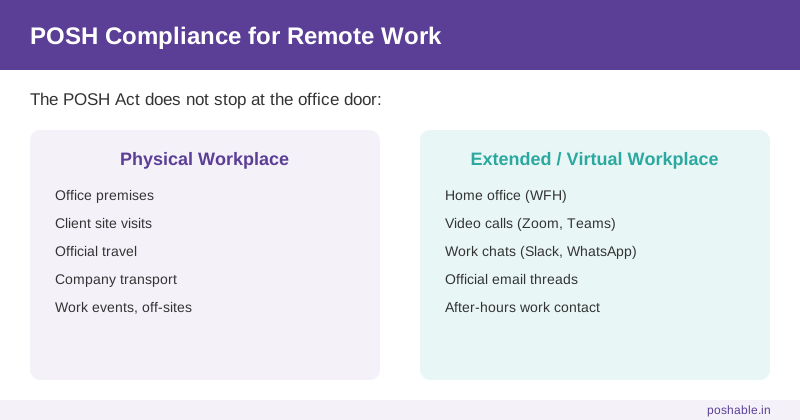
Many organizations treat POSH compliance as an office problem. However, POSH compliance for remote work is not optional just because an employee is logging in from home instead of a desk in the office. Therefore, HR teams and founders alike need to understand exactly how the law extends into hybrid and fully remote setups.
Moreover, as hybrid work becomes permanent rather than a pandemic-era exception, POSH compliance India increasingly means securing video calls, chat platforms, and after-hours communication, not just physical office space. However, many companies still have policies written as if every employee sits in one building. As a result, gaps quietly build up between what the policy says and where employees actually work. Therefore, updating your approach for a distributed workforce is no longer optional.
Request a demo today to see how our POSH compliance solutions can help your organization stay compliant and build a safer workplace.
What You’ll Learn in This Guide
This article covers:
- Whether POSH compliance for remote work is legally required
- How courts have interpreted “workplace” beyond office walls
- What counts as virtual harassment under POSH compliance India
- Which committee handles a complaint from a remote employee
- Policy and training updates distributed teams actually need
POSH Compliance for Remote Work: Does the Law Still Apply?
Yes. Nothing in the Sexual Harassment of Women at Workplace Act, 2013 limits protection to employees physically present in an office. Consequently, the same obligations that apply to a corporate headquarters apply equally to a living room turned home office.
However, the Act itself was written before remote work was common, so it does not use the word “remote” anywhere. Therefore, the real question is not whether the law mentions remote work, but how broadly courts have read the word “workplace.”
POSH Act Workplace Definition: Why “Office” Isn’t the Boundary
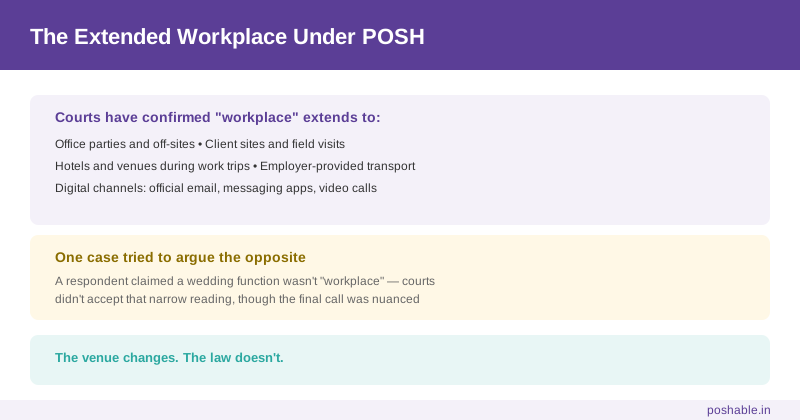
The POSH Act, 2013 defines “workplace” to include any place visited by an employee arising out of or during the course of employment, including transportation provided by the employer. Moreover, Indian courts have consistently read this definition broadly rather than narrowly.
In Saurabh Kumar Mallick v. Comptroller & Auditor General of India (2008), the Delhi High Court held that a narrow, pedantic reading of “workplace” confined to a traditional office could not survive the realities of modern communication technology, including video-conferencing. As a result, this reasoning is now regularly applied to justify extending POSH protections into home offices and virtual meetings.
POSH Compliance for Remote Work: What Counts as Virtual Harassment
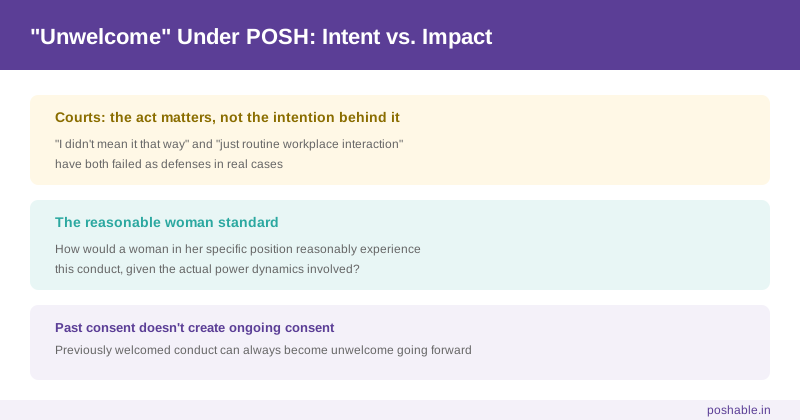
Virtual harassment is not a separate category of law — it is ordinary sexual harassment under Section 2(n), occurring through a different medium. Therefore, the same tests apply: was the conduct unwelcome, and was it of a sexual nature.
Common examples that HR teams need to watch for include:
- Sexually coloured remarks or jokes sent over official chat tools (Slack, Teams, WhatsApp groups)
- Inappropriate visuals or gestures during video calls
- Persistent unwelcome messages outside working hours with a sexual undertone
- Sharing explicit content through work email or messaging apps
Moreover, courts have also held that sending sexually suggestive messages to a colleague through digital channels can independently justify disciplinary action, reinforcing that “online” is not “off the record.”
ICC Jurisdiction for Remote and Hybrid Employees
A remote employee’s complaint is handled exactly the same way as one filed by an on-site employee. Consequently, your existing Internal Committee inquiry process does not change just because the incident happened over video call instead of in a conference room.
However, one practical challenge does change: evidence. Screenshots, chat logs, and call recordings become central to remote-work inquiries in a way they rarely are for in-person incidents. Therefore, ICC members handling a virtual harassment complaint should be trained specifically on preserving and evaluating digital evidence.
POSH Compliance for Remote Work: Policy Checklist Updates
A POSH policy written only with a physical office in mind is now incomplete. Your policy checklist should explicitly state:
- That the policy applies to remote work, video calls, and official chat platforms
- Examples of what virtual harassment looks like, not just physical examples
- How a remote employee can file a complaint without visiting an office
- How the ICC will conduct a fair inquiry when parties are in different cities
Moreover, employees should be told plainly what their rights are under this expanded scope. Our POSH Act rights and responsibilities guide is a useful reference to share during onboarding, remote or otherwise.
POSH Training for Employees Working From Home
POSH training for employees cannot assume a shared physical space. As a result, training content needs to explicitly cover digital conduct: appropriate video call behavior, chat etiquette, and the boundaries of after-hours contact.
Therefore, remote-first companies should treat digital conduct training as a core module, not an afterthought bolted onto a generic session designed for an office environment.
Common Digital Harassment Scenarios HR Teams Miss
Some of the most common blind spots in POSH compliance for remote work are not overtly sexual on their face, which is exactly why they get missed.
- Digital isolation: deliberately excluding someone from meetings or threads in a gendered pattern
- Boundary-blurring contact: late-night messages with a personal or suggestive undertone framed as “just work”
- Camera-related pressure: insisting a colleague keep video on with inappropriate commentary about appearance
Consequently, managers need training on these patterns specifically, since they rarely resemble the textbook examples used in generic POSH sessions.
POSH Compliance for Remote Work: Documentation for Complaints
Good documentation matters even more when a complaint involves remote or hybrid work. Records should include:
- Screenshots or exports of the relevant chat, email, or call log
- Timestamps establishing that the interaction occurred during or arising out of work
- A clear record of the ICC’s inquiry, exactly as it would maintain for an in-person case
Moreover, this is precisely the kind of gap a POSH audit is designed to catch — inspectors increasingly ask whether a company’s policy and records account for remote and hybrid scenarios at all.
Consequences of Ignoring Virtual Workplace Harassment
Treating virtual harassment as somehow “less serious” than in-person harassment is a mistake with real consequences. As a result, companies that dismiss digital complaints risk the same statutory penalties, reputational damage, and loss of employee trust as those that ignore an in-person incident.
Request a demo today to see how our POSH compliance solutions can help your organization stay compliant and build a safer workplace.
POSH Compliance Services for Distributed Teams
Many organizations work with POSH compliance services to update policies and run training that genuinely reflects a hybrid workforce, rather than retrofitting an office-era policy. Moreover, an experienced partner can help your ICC build the specific muscle of investigating digital evidence, which is a different skill from a purely in-person inquiry.
Common Mistakes Companies Make with Remote POSH Compliance
- Assuming remote means reduced risk, rather than a different risk surface
- Leaving policies unchanged since the shift to hybrid work
- Treating chat and video incidents as informal rather than formal complaints
- Failing to train ICC members on preserving digital evidence
Conclusion: POSH Compliance for Remote Work Starts With Policy, Not Location
In conclusion, POSH compliance for remote work is not a gray area — it is the same law, applied to a different set of physical and digital spaces. Moreover, as courts continue to read “workplace” broadly, the safest approach for any organization is to assume full applicability rather than wait for a case to test the boundary. Therefore, updating your policy, training, and documentation for a hybrid reality should be treated as core POSH compliance India work, not an optional add-on.
Request a demo today and discover how our expert-led POSH compliance services can help your organization stay compliant, reduce risk, and build a safer workplace — wherever your team is working from.