
A strong POSH compliance checklist for startups is essential for every early-stage business that wants to build a safe and legally sound workplace from day one. While many founders assume POSH obligations only apply once they scale up, the law works differently. Therefore, understanding POSH compliance for startups from the very first hire helps avoid painful scrambles later.
Moreover, a startup that builds POSH compliance India habits early not only avoids legal risk but also signals a safer culture to early employees and investors. However, many founders are unsure exactly when obligations kick in and what changes as headcount grows. As a result, important compliance gaps often go unnoticed until a funding due-diligence check or an employee complaint forces the issue. Therefore, understanding a practical POSH compliance checklist can help startups stay prepared at every stage of growth.
Request a demo today to see how our POSH compliance solutions can help your organization stay compliant and build a safer workplace.
What You’ll Learn in This Guide
This article covers:
- Whether POSH compliance for startups applies below 10 employees
- The exact employee threshold that changes your obligations
- What a compliant POSH policy checklist must include
- Internal Committee vs Local Committee for small businesses
- Penalties for non-compliance startups cannot afford to risk
POSH Compliance for Startups: Does the Law Apply to You?
Yes. POSH Act 2013 compliance applies to every workplace in India, regardless of size, sector, or funding stage. Consequently, a four-person startup operating out of a co-working space carries the same underlying legal obligation as a 500-person enterprise.
However, what changes with headcount is not whether the law applies, but which mechanism handles a complaint. Therefore, founders should stop asking “are we too small for POSH” and start asking “which POSH compliance checklist applies to our current headcount.”
POSH Act Applicability: The 10-Employee Threshold Explained
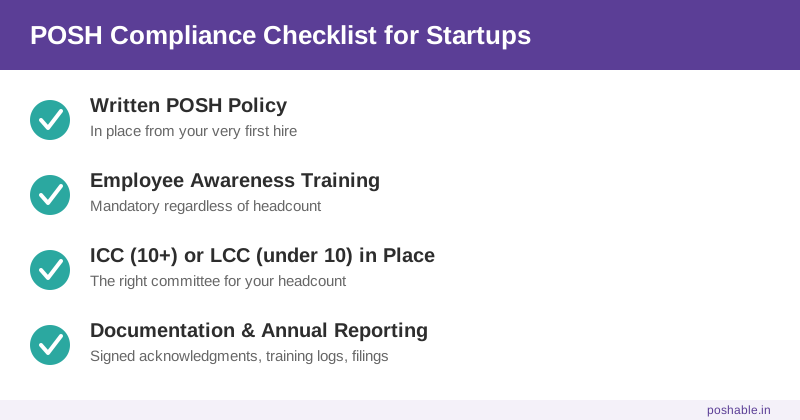
A POSH compliance checklist for startups always starts with one number: 10 employees. This threshold determines your committee structure, not your legal obligation.
- 10 or more employees: the organization must constitute an Internal Complaints Committee (ICC)
- Fewer than 10 employees: complaints are routed to the district-level Local Complaints Committee (LCC)
- “Employees” includes contractual, temporary, and part-time staff, interns, and consultants
Moreover, this count is not limited to one office. As a result, a startup with 6 employees in Bengaluru and 5 in Pune has crossed the threshold and needs an ICC, even though each individual location looks small on paper.
POSH Compliance India for Businesses Under 10 Employees
Founders of very early-stage startups often assume no committee means no obligations. However, this is one of the most common and costly myths in POSH compliance India.
Businesses under 10 employees must still:
- Maintain a written POSH policy
- Conduct employee awareness and orientation sessions
- Help any employee who wishes to complain reach the Local Complaints Committee
Therefore, “we are too small for all this” is not a defense the law recognizes. Consequently, early POSH compliance for startups should be treated as a founding-document task, alongside incorporation and payroll setup.
POSH Policy Checklist: What Every Startup Must Have in Writing
A written POSH policy checklist should clearly define the following:
- Definition of sexual harassment as covered under the POSH Act, 2013
- Complaint filing process and timelines — see our POSH Act rights and responsibilities guide for what this means for employees
- Committee structure (ICC or LCC, depending on headcount)
- Confidentiality obligations
- Consequences for false or malicious complaints
Moreover, this policy should be shared with every new hire during onboarding, not buried in a handbook nobody reads. As a result, awareness becomes part of company culture rather than a compliance afterthought.
Internal Committee vs Local Committee for Small Businesses
Workplace harassment compliance depends heavily on knowing which committee actually has jurisdiction over your organization — and, once formed, how that Internal Committee actually runs an inquiry.
| Headcount | Handling Body | Who Constitutes It |
|---|---|---|
| 10 or more employees | Internal Complaints Committee (ICC) | The employer |
| Fewer than 10 employees | Local Complaints Committee (LCC) | The District Officer |
| Complaint against the employer | Local Complaints Committee (LCC) | The District Officer |
Consequently, once a startup crosses 10 employees, forming the ICC is not optional or gradual — it becomes an immediate obligation under Section 4 of the Act.
POSH Training for Employees: Why Startups Can’t Skip It
POSH training for employees is often the first thing cut from a lean startup budget. However, awareness sessions are a mandatory part of POSH compliance India, not an optional culture perk.
Effective training typically covers:
- What behavior qualifies as sexual harassment under the Act
- How and where to file a complaint
- Protection against retaliation for complainants and witnesses
Therefore, building this into new-hire onboarding from day one is far cheaper than retrofitting it after an incident.
Documentation Startups Need for POSH Compliance
A complete POSH compliance checklist always includes documentation, even for the smallest teams.
- Signed acknowledgment of the POSH policy from every employee
- Training attendance records
- ICC constitution order, once formed (10+ employees)
- Annual report to the District Officer, once an ICC exists
Moreover, incorporated startups should note that the Ministry of Corporate Affairs requires listed and certain private companies to disclose POSH compliance status in their annual board report. Consequently, weak documentation can surface as a red flag well beyond HR — in statutory filings and investor due diligence alike. Once an ICC is formed, organizations are also expected to register it on the government’s SHe-Box portal, the centralized platform for tracking Internal and Local Committees nationwide.
Consequences of Non-Compliance for Small Businesses
Ignoring POSH Act 2013 compliance carries real financial and reputational consequences, even for very small teams.
- Fine of up to ₹50,000 for a first-time contravention
- Higher penalties for repeat non-compliance
- Possible cancellation or non-renewal of licenses or registration needed to operate the business
As a result, the cost of ignoring a POSH compliance checklist is rarely limited to the fine itself — it extends to investor confidence, employer brand, and in some cases, the ability to keep operating. These are exactly the gaps a POSH audit is designed to catch before an inspector does.
POSH Compliance Services for Growing Startups
Many founders work with POSH compliance services rather than building this in-house from scratch. Moreover, an outside compliance partner can help draft policy documents, run training sessions, and prepare the organization for the exact day it crosses the 10-employee threshold.
Request a demo today to see how our POSH compliance solutions can help your organization stay compliant and build a safer workplace.
Common Mistakes Startups Make with POSH Compliance
- Assuming size exempts them from any POSH obligation at all
- Waiting until 10 employees to write any policy at all
- Treating training as optional rather than a compliance requirement
- Losing track of headcount across multiple offices or remote hires
Conclusion: A POSH Compliance Checklist Startups Should Build Early
In conclusion, POSH compliance for startups is not a scaling-stage problem — it is a founding-stage responsibility under POSH Act 2013 compliance. Moreover, organizations that put a written policy, training, and documentation in place early are far better positioned once they cross the 10-employee threshold and must stand up a full Internal Complaints Committee. As a result, startups avoid last-minute scrambles, reduce legal risk, and build workplace trust from the very first hire. Therefore, treating POSH compliance India as a day-one checklist, not a day-100 fire drill, should be a priority for every founder.
Request a demo today and discover how our expert-led POSH compliance services can help your organization stay compliant, reduce risk, and build a safer workplace.