
POSH for interns is a legal question, not a policy choice. Many employers treat interns, trainees and contract workers as outside the Act because they are not on the payroll. However, the Act’s definitions say otherwise. Section 2(f) and Section 2(a) together reach well beyond permanent staff.
How POSH for Interns Works Under Section 2(f)
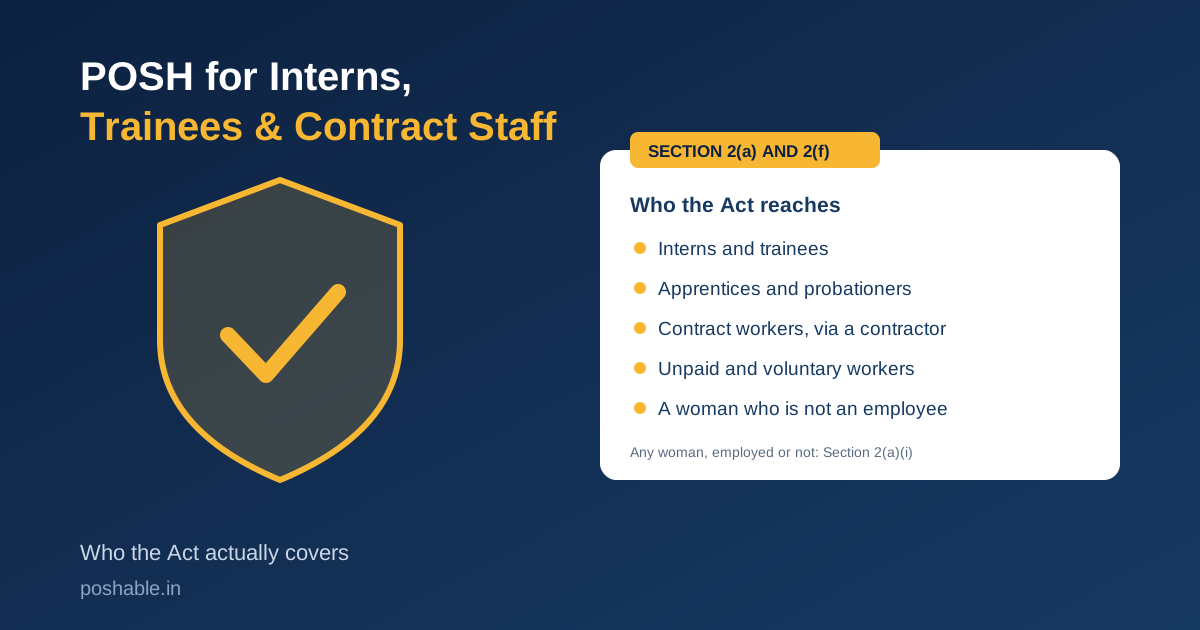
Section 2(f) defines an employee as a person employed at a workplace for any work on a regular, temporary, ad hoc or daily wage basis. The engagement can be direct, or through an agent, including a contractor, with or without the principal employer’s knowledge. In addition, it can be for remuneration or not, or on a voluntary basis. Finally, the definition names co-workers, contract workers, probationers, trainees and apprentices.
Section 2(f) does not use the word intern. Even so, an intern fits the definition in several ways. An unpaid intern works “whether for remuneration or not”. Similarly, a short internship is temporary work. Likewise, a graduate trainee is a trainee. The definition also covers a worker “called by any other such name”, so the label on an offer letter does not decide the question.
Aggrieved Woman: Employment Is Not Required
Section 2(a)(i) defines an aggrieved woman, in relation to a workplace, as a woman of any age, whether employed or not, who alleges sexual harassment by the respondent. That wording matters. For example, a job candidate or a visitor may not qualify as an employee under Section 2(f). Still, she can be an aggrieved woman.
The Supreme Court quoted this definition in Dr. Sohail Malik v. Union of India (2025 INSC 1415), decided on 10 December 2025. The Court held that the Internal Committee at the aggrieved woman’s workplace can inquire even where the respondent works in a different department. It also said a narrower reading would undercut the Act’s remedial purpose. The Court did not separately analyse the words “whether employed or not”. You can read the judgment on the Supreme Court website.
Contract Workers and the Principal Employer
Section 2(f) covers workers engaged through a contractor, with or without the principal employer’s knowledge. Section 2(g)(iii) adds that the employer also includes the person discharging contractual obligations with respect to his or her employees. So responsibility can sit with more than one party.
Therefore, written clarity is important. Your contracts should say which Internal Committee handles a contract worker’s complaint. They should also say how the contractor will cooperate. In Sohail Malik, the Court directed the respondent’s employer to cooperate swiftly with the committee’s requests for information. So a contractor clause can build the same duty into your agreements. Our guide to gig and platform workers covers a related set of engagement models.
What This Means for Employers
- Name interns, trainees, apprentices and volunteers in your POSH policy.
- Brief every intern on how to reach the Internal Committee.
- Treat unpaid and short-term status as irrelevant to coverage.
- Spell out committee and cooperation duties in contractor agreements.
- Train committee members to handle complaints from visitors and other non-employees.
Common Mistakes About POSH for Interns
- Excluding unpaid interns from the policy and the training.
- Assuming that a contractor’s workers fall only under the contractor.
- Relying on the label in the offer letter.
- Forgetting that a visitor can be an aggrieved woman.
- Skipping intern onboarding because the placement is short.
For the training side, see our guide to POSH training requirements. The extended workplace guide explains where the workplace reaches beyond the office. For the committee itself, see Internal Committee composition.
Building POSH for Interns Into Your Policy
Your policy should name interns, trainees, apprentices, volunteers and contract workers. It should also explain how each can reach the committee. The Act protects only women, so consider a separate gender-neutral process for male interns. Our post on whether the POSH Act protects men explains the limits, and our POSH policy checklist lists what the document must contain.
Need help updating your policy or briefing your interns? Request a demo today and our team will walk you through it.