
This is the exact question at the heart of POSH for gig workers: a woman is sexually harassed by a driver on a ride-hailing app. She complains to the platform’s Internal Committee. The committee refuses to investigate, because the driver is not technically an “employee.” This is not a hypothetical. It happened, and in 2024 a High Court finally weighed in.
However, the answer it gave lasted exactly four days before an appeal put it on hold. Therefore, POSH for gig workers is currently one of the most unsettled, and most consequential, questions in Indian employment law.
Request a demo today to see how our POSH compliance solutions can help your organization stay compliant and build a safer workplace.
What You’ll Learn in This Guide
This article covers:
- The legal grey zone platforms have relied on for years
- What the Karnataka High Court actually ruled about Ola drivers
- Why that ruling was stayed almost immediately
- What “stayed” does and does not mean for platforms today
- A practical checklist for aggregators regardless of how this resolves
POSH for Gig Workers: Why This Question Suddenly Matters
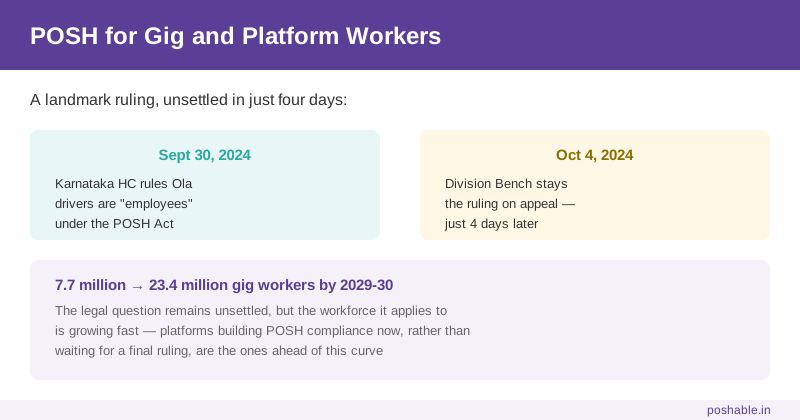
India’s gig workforce is genuinely large. NITI Aayog estimates roughly 7.7 million gig workers in 2020-21, projected to reach 23.4 million by 2029-30. Moreover, a meaningful share of that workforce interacts directly with the public: cab drivers, delivery partners, and home-service professionals. Therefore, the question of whether POSH protections reach them is not academic.
POSH for Gig Workers: The Legal Grey Zone Platforms Rely On
Most aggregator platforms classify their workers as independent contractors, not employees. Consequently, many have argued their Internal Committees simply lack jurisdiction over harassment involving these workers, whether as the accused or, in principle, as a complainant.
A Landmark POSH Ruling: Ola Drivers Are “Employees”
In 2018, a woman was sexually harassed during an Ola ride. She complained through Ola’s Internal Committee, which declined jurisdiction, arguing the driver was an independent contractor. She filed a writ petition in the Karnataka High Court.
What the Karnataka High Court Actually Found
On September 30, 2024, in Ms. X v. Internal Complaints Committee, ANI Technologies Pvt. Ltd., a single judge held that Ola’s driver-subscribers were “employees” under Section 2(f) of the POSH Act, 2013. The Court found that Ola exercised a level of control over drivers inconsistent with treating them as mere independent contractors, especially while marketing a “zero tolerance” safety policy to riders. It ordered Ola’s Internal Committee to investigate the complaint and awarded the petitioner ₹5,00,000 in compensation.
Then, Just Four Days Later, It Was Stayed
On October 4, 2024, a Division Bench of the same High Court stayed the ruling on Ola’s appeal. Therefore, the single judge’s reasoning remains influential, but it is not currently binding law. Consequently, no platform can point to this case today and say the question is settled.
POSH for Gig Workers: What “Stayed” Actually Means
A stay pauses enforcement of the specific order while the appeal proceeds. It does not erase the underlying reasoning, and it does not mean the Division Bench disagreed with it. However, it does mean employers cannot treat this ruling as final precedent just yet, and platforms should not assume the outcome either way.
The Bigger Pattern: Courts Reading “Employee” Broadly
This case did not emerge from nowhere. A separate, still-pending Supreme Court petition, filed by the Indian Federation of App-Based Transport Workers, challenges the independent-contractor classification more broadly. Moreover, the central government’s own 2023 guidelines for “aggregators” already treat platforms like Swiggy, Zomato, Uber, and Urban Company as a distinct, regulated category. Therefore, the direction of travel looks fairly consistent, even while the destination stays undecided.
POSH for Gig Workers: What Platforms Should Do Today
Waiting for final clarity is a risky strategy. A more sensible approach treats gig and platform workers as covered, well ahead of any court requiring it.
Practical Checklist for Platforms and Aggregators
- Extend the Internal Committee’s stated jurisdiction to cover complaints involving driver-partners and delivery partners
- Build a complaint channel that a customer, not just a fellow worker, can actually use
- Train customer-support staff to escalate harassment complaints rather than close them as “service issues”
- Keep records the way any properly functioning IC would, in case jurisdiction is challenged later
POSH for Gig Workers: What It Means for Women Using These Platforms
For now, a complaint against a gig worker may still meet resistance from a platform citing this exact legal uncertainty. However, the Karnataka High Court’s reasoning gives complainants a real, citable argument, even while the appeal remains pending.
Common Mistakes Platforms Are Making Right Now
- Treating “stayed” as “decided in our favor”, when it simply means undecided
- Having no complaint channel at all for incidents involving gig workers
- Assuming this only affects ride-hailing, when the reasoning could extend to delivery and home-service platforms too
- Waiting for the Supreme Court instead of building the compliance infrastructure now
Request a demo today to see how our POSH compliance solutions can help your organization stay compliant and build a safer workplace.
POSH Compliance Services for Non-Traditional Workplaces
Many organizations bring in POSH compliance services specifically to think through jurisdiction questions like this one before a complaint forces the issue. A platform that has already extended its compliance framework to gig workers is in a far stronger position than one still arguing about definitions.
Conclusion: POSH for Gig Workers Is Coming, Ready or Not
In conclusion, the legal question of POSH for gig workers remains genuinely open, with a landmark ruling currently stayed on appeal. Moreover, the broader trend, from the Karnataka High Court’s reasoning to the pending Supreme Court petition to the government’s own aggregator guidelines, points in one consistent direction. Therefore, platforms that build POSH-ready processes for their gig workforce now, rather than waiting for a final answer, will be the ones genuinely prepared when one arrives.
Request a demo today and discover how our expert-led POSH compliance services can help your organization stay compliant, reduce risk, and build a safer workplace.