
Every workplace worries about this eventually. What actually counts as a POSH false complaint? However, the honest answer surprises most people: Section 14 sets a genuinely high bar, and courts have shown they take that bar seriously, even reversing themselves when they get it wrong.
Moreover, understanding POSH false complaint rules matters for two very different audiences. Genuine complainants need to know a failed case does not automatically brand them liars. Respondents need to know the law does punish deliberate fabrication. Therefore, both sides benefit from knowing exactly where this line sits.
Request a demo today to see how our POSH compliance solutions can help your organization stay compliant and build a safer workplace.
What You’ll Learn in This Guide
This article covers:
- What actually counts as a false or malicious complaint
- Why an unproven complaint is not the same thing
- A real case where a court got this wrong, then corrected itself
- Penalties for filing a genuinely false complaint
- What this means for respondents and committees alike
POSH False Complaint Rules: What Section 14 Actually Says
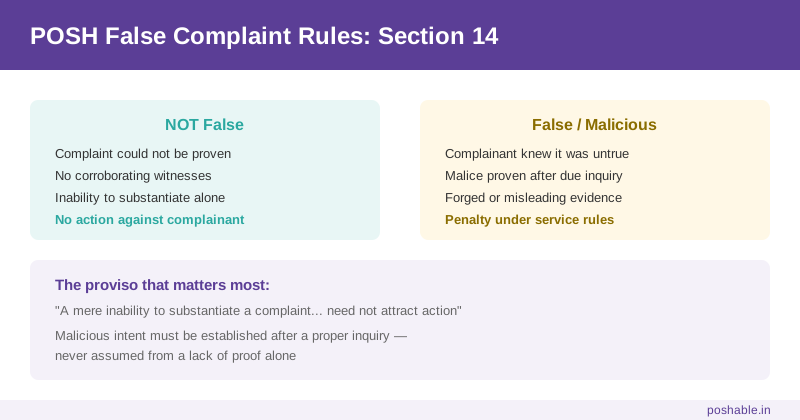
Under Section 14 of the POSH Act, 2013, an Internal Committee can recommend action against a complainant only where it concludes the allegation is malicious, the complaint was filed knowing it to be false, or forged evidence was produced. Notably, this same provision extends to witnesses who give false evidence, not just the complainant herself.
The Line Between Unproven and False
Here is the distinction most people miss. Section 14 explicitly states that a mere inability to substantiate a complaint, or to provide adequate proof, does not by itself justify action against the complainant. Consequently, a case that simply fails on evidence is not automatically a false complaint. It is just a complaint the committee could not prove.
Malicious Intent Must Be Proven, Not Assumed
The Act adds a second safeguard. Malicious intent has to be established through a proper inquiry, following the prescribed procedure, before any action is recommended. Therefore, an IC cannot shortcut this by simply inferring bad faith from a weak case. It must actively investigate and prove malice as its own separate finding.
A Cautionary Case: When a Court Got This Wrong
The case widely cited as India’s leading example of a “false complaint” is Anita Suresh v. Union of India. In 2019, a Single Judge of the Delhi High Court held the complainant’s allegations false, partly because she could not name witnesses and partly based on her past service record. The Court imposed costs of ₹50,000 and permitted her employer to take action against her.
However, this is where most articles on this case stop, and that is exactly the problem.
What the Appellate Court Actually Said
In December 2020, the Division Bench of the Delhi High Court heard her appeal and set aside the entire order. It held that the Single Judge was wrong to treat the absence of corroborating witnesses as proof of falsity, wrong to rely on her past service record at all, and wrong to ignore that the respondent himself admitted making the remarks in question.
Moreover, the Division Bench went further, laying out principles every committee should internalize: the standard of proof in an IC inquiry mirrors a domestic inquiry, not a criminal trial, and a complainant’s credibility should never hinge on whether she can produce an eyewitness to something that, by its nature, usually happens behind closed doors.
POSH False Complaint Penalties Under Section 14
Where malice is genuinely proven, the IC may recommend penalties in line with the applicable service rules, or as otherwise prescribed if none exist. As a result, the consequences mirror those for other POSH violations already covered elsewhere on this site: no fixed statutory fine, but real disciplinary exposure through the employer’s own rules.
False Evidence and Witnesses Are Covered Too
Section 14 does not stop at the complainant. Anyone, including a witness, who produces forged or misleading documents faces the same exposure. Therefore, committees should treat suspected fabricated evidence as seriously as a fabricated complaint itself.
What This Means for Respondents
Respondents sometimes assume Section 14 gives them an easy counter-move: simply allege the complaint was false. However, the Anita Suresh reversal shows exactly why that rarely works on a weak record. Genuine malice requires its own proof, not just a complainant’s inability to fully corroborate her account.
Documentation Checklist for Committees
Before recommending action under Section 14, committees should have on file:
- A specific, reasoned finding on malicious intent, separate from the main inquiry outcome
- Evidence the complainant knew the allegation to be false, not merely that it went unproven
- Records showing the committee’s full membership applied its mind jointly to this specific question
- A clear separation between the credibility assessment and the complainant’s employment history
Common Mistakes Committees Make with False Complaint Claims
- Treating an unproven complaint as automatically false, contrary to the Act’s own proviso
- Relying on past service records to judge the credibility of a specific complaint
- Requiring eyewitness corroboration as if its absence alone defeats a complainant
- Skipping a distinct malice inquiry before recommending Section 14 action
Request a demo today to see how our POSH compliance solutions can help your organization stay compliant and build a safer workplace.
POSH Compliance Services for Committee Training
Many organizations bring in POSH compliance services specifically so committees understand this distinction before a difficult case ever arrives. A well-trained IC protects genuine complainants from being wrongly disbelieved, while still holding truly malicious complaints, and fabricated evidence, properly accountable.
Conclusion: POSH False Complaint Rules Protect Everyone, Carefully
In conclusion, POSH false complaint rules under Section 14 exist to punish deliberate fabrication, not to second-guess every complaint that fails on evidence. Moreover, as the Anita Suresh reversal shows, even courts can get this distinction wrong on a first pass. Therefore, committees should apply the same careful, two-step standard the Act itself demands: first, a complaint must actually fail; second, malice must be separately and affirmatively proven before anyone recommends punishing the person who came forward.
Request a demo today and discover how our expert-led POSH compliance services can help your organization stay compliant, reduce risk, and build a safer workplace.