
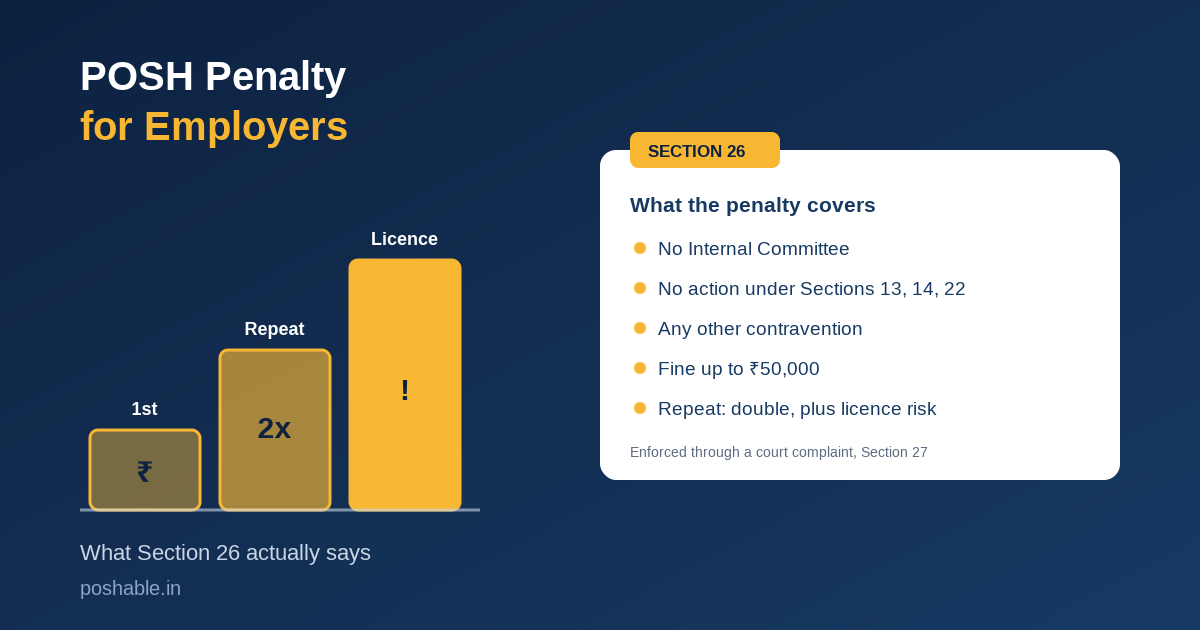
The POSH penalty in Section 26 looks small. A fine of up to ₹50,000 does not worry most finance teams. However, the Act adds a second step for repeat offenders, and that step can reach your business licences. It also takes a prosecution to impose, which changes how the risk actually arrives.
What the POSH Penalty Covers
Section 26(1) fines an employer who fails to constitute an Internal Committee under Section 4(1). It also covers a failure to take action under Sections 13, 14 and 22. In addition, a third limb catches an employer who contravenes, attempts to contravene or abets a contravention of any other provision of the Act or its rules. The fine may extend to ₹50,000.
Each limb also maps to a duty you already know. The committee itself comes from Section 4(1). Under Section 13, the employer must act on a recommendation, and Section 13(4) sets sixty days for that. A false or malicious complaint triggers Section 14. Finally, Section 22 requires the employer to report case numbers in its annual report, or to tell the District Officer where no annual report is prepared. Our checklist on the duties of the employer under Section 19 covers the wider set of obligations that the third limb can reach.
What Happens on a Repeat Offence
Section 26(2) applies when an employer is convicted of the same offence again after an earlier conviction. The employer then becomes liable to twice the earlier punishment, subject to the maximum for that offence. The employer also becomes liable to cancellation, withdrawal or non-renewal of any licence or registration needed to carry on the business. A proviso asks the court to take account of any higher punishment that another law prescribes for the same offence.
How the POSH Penalty Is Enforced
Section 26 does not work like an automatic regulatory fine. Instead, a court must convict first. Under Section 27, no court takes cognizance of an offence under the Act except on a complaint by the aggrieved woman or by a person authorised by the Internal Committee or Local Committee. Also, no court below a Metropolitan Magistrate or a Judicial Magistrate of the first class can try the offence. The Act also makes every offence non-cognizable, which limits police action without a Magistrate’s order.
In practice, the first step is usually a complaint from the aggrieved woman or an authorised committee member. A missing committee can therefore become your problem the moment a complaint arrives.
What the Supreme Court Has Said About Enforcement
The Supreme Court has pushed enforcement hard. On 3 December 2024, a bench of Justices B.V. Nagarathna and N.K. Singh issued directions in Aureliano Fernandes v. State of Goa, heard with Initiatives for Inclusion Foundation v. Union of India. The Court told District Officers to ensure that Internal Committees are constituted in organisations in their districts. It also asked them to cite the Section 26 penalty for employers who fail to do so. It also directed Chief Secretaries to have District Magistrates survey public and private organisations that have constituted committees. The LiveLaw report lists every direction.
The same directions also require each district to have a notified District Officer, a Local Committee and nodal officers. So where an establishment has fewer than ten workers, or the complaint is against the employer, the Local Committee receives it. Our guide to the Local Complaints Committee explains how that route works.
What This Means for Employers
- Constitute the Internal Committee before the first complaint, not after it.
- Act on every recommendation within sixty days, and keep proof of what you did.
- Report case numbers every year, in the annual report or to the District Officer.
- Keep records that show the Section 19 duties are met.
- Treat any earlier conviction as a licence risk, not just a fine.
Common Mistakes About the POSH Penalty
- Assuming that ₹50,000 is the whole exposure.
- Treating a missing Internal Committee as a paperwork gap.
- Letting the sixty-day deadline for acting on a recommendation lapse.
- Overlooking that the Section 22 disclosure also sits inside Section 26.
- Forgetting that a repeat conviction can touch your licences.
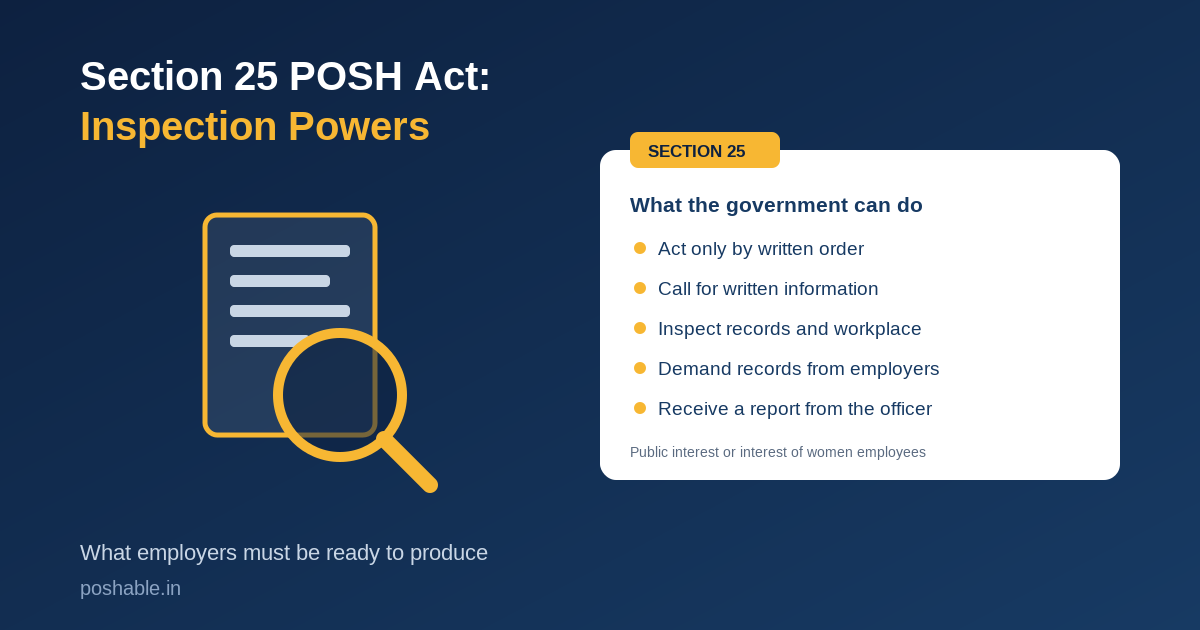
For a view of what inspectors check, read our POSH audit checklist. The Maharashtra inspection circular shows how one state turns these duties into a checklist. Our guide to the annual report under Section 21 covers the reporting side.
Building the POSH Penalty Into Your Compliance Calendar
Your compliance calendar should list the committee’s constitution date, each sixty-day action deadline and the annual disclosure. It should also name who owns each date. Dated records then turn a penalty risk into a routine check. Remember that a court decides the actual penalty, so a clean record is your best protection.
Need a compliance calendar or a committee refresh? Request a demo today and our team will walk you through it.