
POSH compliance in India has mostly run on an honour system. A company files an annual report. It confirms an Internal Committee exists on paper. Nothing more happens unless an employee complains. Maharashtra issued the POSH inspection circular on May 14, 2026, and it changes that. It directs officials to physically inspect workplaces against a detailed checklist, whether or not anyone has ever filed a complaint.
This is the first time an Indian state has activated proactive, checklist-based POSH inspections at scale. Employers in Maharashtra should treat it as a live enforcement mechanism, not a press release.
What the Maharashtra POSH Inspection Circular Says
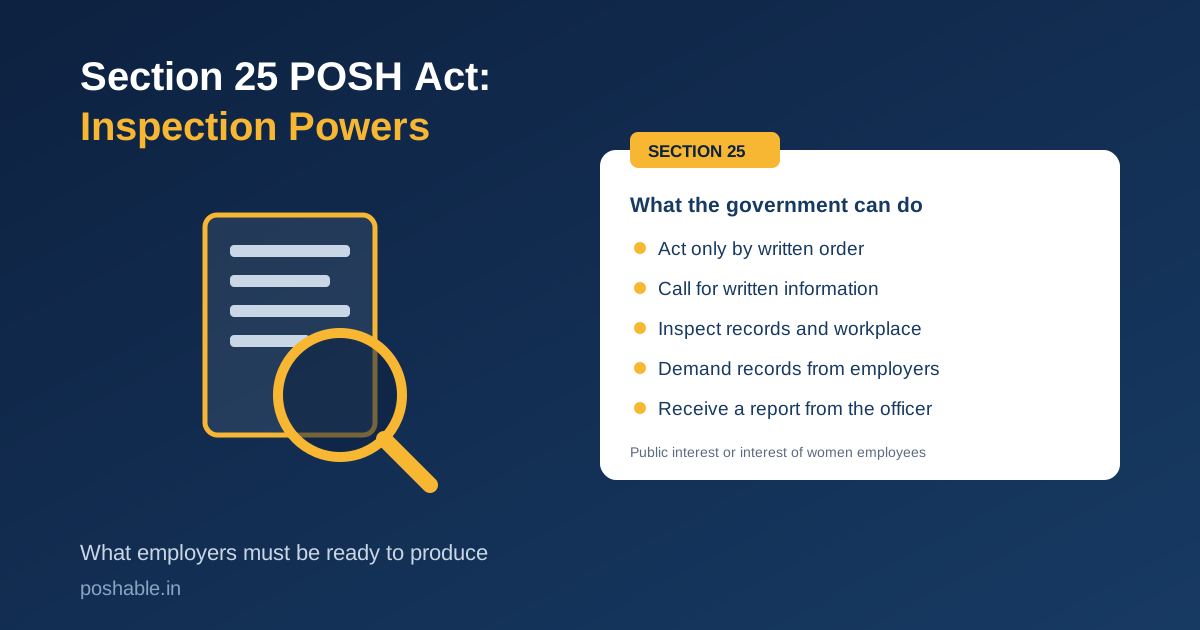
The circular draws its authority from Section 25 of the Sexual Harassment of Women at Workplace (Prevention, Prohibition and Redressal) Act, 2013. That provision has always let the government appoint inspecting officers. What changed in May 2026 is that Maharashtra activated it.
The Maharashtra State Commission for Women directed district collectors and divisional commissioners to complete a state-wide audit of Internal Committees. The circular gives them a 30-day window. The Women and Child Development Department supplies the inspecting officers (AZB Partners’ summary of the circular).
This sets up standing inspection authority, not a one-time drive. Officers can return to the same establishment later. A gap found once does not close the file.
Who the Circular Applies To
The circular covers government, semi-government, and private establishments across Maharashtra. It applies regardless of sector or company size. If you employ people in the state, this reaches you, whether you are headquartered there or run a branch office.
Companies often assume a policy drafted for their registered office covers every location. That assumption is getting riskier. Regulators increasingly expect a single policy across every location rather than a policy that quietly stops at the head office door.
Inside the Compliance Checklist
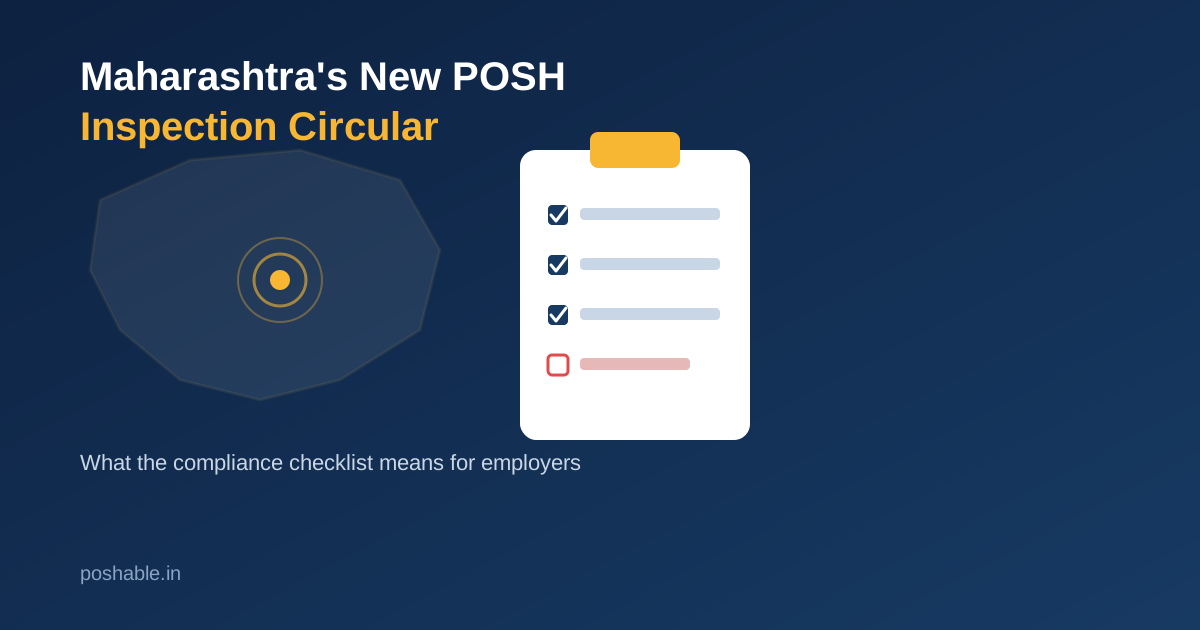
Inspecting officers are working through a detailed checklist. Our POSH audit checklist already breaks down what inspectors typically look for. Under this circular, officers are specifically verifying:
- Internal Committee constitution — correct composition, valid tenure, and an external member who genuinely meets the Act’s qualifications
- Policy dissemination — evidence employees have seen and understood the policy, not just that a document exists somewhere
- Complaint handling procedures — documented timelines matching the Act’s 90-day inquiry window
- SHe-Box portal registration — whether the establishment actually appears on it with current details
- Record maintenance and annual reporting — inquiry records and past annual reports available on demand
- Remote and virtual work protocols — whether the policy addresses the extended workplace under POSH at all
- Availability of records at the time of inspection — officers can ask to see documentation immediately
What Happens If You Fail a Maharashtra POSH Inspection
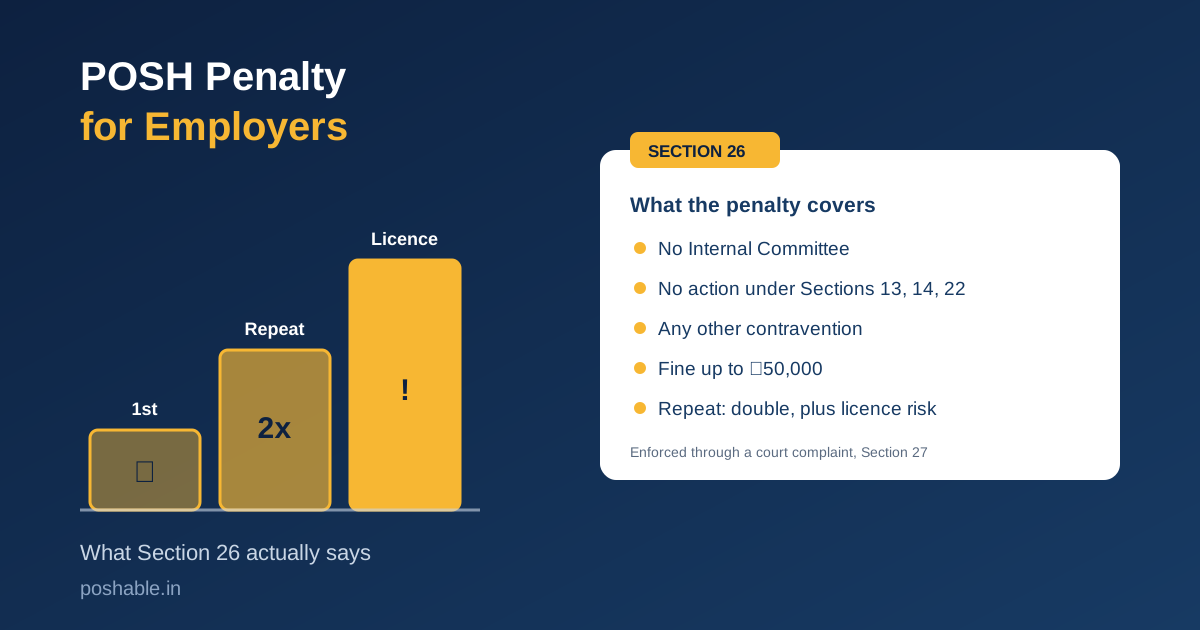
The circular states plainly that penalties may follow when officers find deficiencies. These include monetary fines and other action prescribed under the POSH Act. The Act already allows fines for a first offence. Repeat non-compliance can mean cancelled business licences or registrations.
What genuinely changes here is enforcement probability. A gap that used to stay invisible until an employee complained can now surface during a routine visit.
Why This Matters Outside Maharashtra Too
POSH enforcement nationally has been mostly reactive. Litigation, media coverage, or a single complaint usually triggers it, not a proactive audit. Maharashtra is one of India’s largest states by workforce. Other states tend to study and adapt its labour compliance circulars within a year or two.
Employers outside Maharashtra should read this as an early signal, not a problem confined to one state.
How to Prepare Before an Inspector Shows Up
A few checks now cost far less than a failed inspection later:
- Re-verify Internal Committee composition and the external member’s qualifications
- Pull the last two years of annual reports and confirm you actually filed them with the District Officer
- Register on SHe-Box if you haven’t already, and keep the listing current
- Refresh training records — a signature on a policy is not proof employees understood it
- Review whether your policy language actually covers remote and field-based work
- Assemble a document folder you can show an inspector the same day
Building this under deadline pressure is exactly what POSHable helps you avoid. Request a demo today to see where your current policy and Internal Committee would stand up against this checklist. Or read our About Us to see how we work with companies on exactly this.