
On paper, POSH for domestic workers is a genuine legal achievement. India’s law explicitly extends protection to women whose workplace is someone else’s home, a group most labour law simply leaves out. However, a district committee set up specifically to serve them recently confirmed it received zero complaints from domestic workers in an entire year. Not because harassment isn’t happening. Because the system meant to catch it barely functions.
Moreover, this gap between legal text and lived reality is exactly what makes this topic worth examining honestly, rather than just restating what the law says it will do.
Request a demo today to see how our POSH compliance solutions can help your organization stay compliant and build a safer workplace.
What You’ll Learn in This Guide
This article covers:
- What the law actually promises domestic workers
- How the Local Committee and Nodal Officer system is supposed to work
- What recent reporting has found about whether it actually does
- Why domestic workers often don’t report harassment at all
- What individual employers of domestic workers should actually do
POSH for Domestic Workers: What the Law Actually Promises
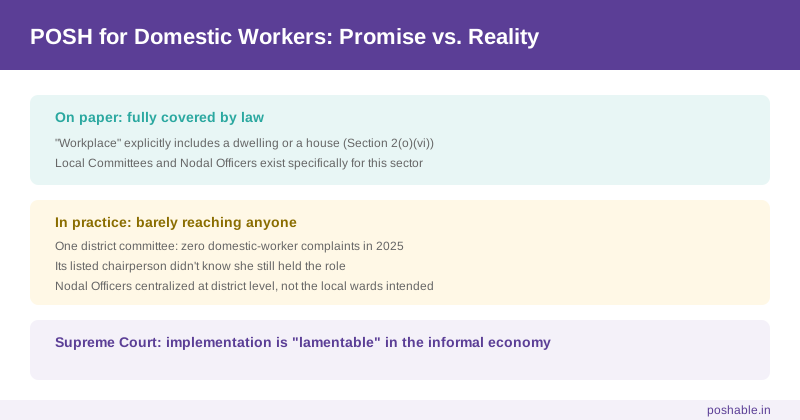
Under Section 2(o)(vi) of the POSH Act, 2013, “workplace” explicitly includes a dwelling place or a house. This single clause is what makes domestic workers fall within the Act’s protection at all, unlike most Indian labour law, which routinely excludes informal, home-based work entirely.
The Legal Mechanism: Local Committees and Nodal Officers
Since a household cannot realistically form its own Internal Committee, domestic workers route complaints through the district-level Local Committee instead. Nodal Officers are meant to sit at the block, taluka, tehsil, ward, or municipality level. They exist specifically to give women a nearby point of contact, rather than forcing them to navigate an entire district bureaucracy alone.
What “Workplace” Means When Home Is the Job Site
This extension matters because domestic work carries risks most office-based employment doesn’t. A worker is often alone with her employer, inside a private residence, with no colleagues nearby and no obvious witnesses. Therefore, the redressal mechanism has to work well. The informal, isolated nature of the job makes harassment both more likely and harder to prove.
POSH for Domestic Workers: What Investigation Actually Found
Recent reporting has tested how well this system actually functions, and the results are sobering. Journalists contacting a district Local Committee found its publicly listed chairperson no longer held that role and had to redirect them to someone else entirely. When asked directly how many domestic worker complaints the committee had received that year, officials confirmed the number was zero. This wasn’t because harassment wasn’t occurring. It was because the mechanism wasn’t reaching the women it exists to protect.
A District Committee That Received Zero Complaints
Zero complaints from an entire district’s domestic worker population, in a country where such harassment is well documented, is not evidence of safety. It is evidence of an access problem. Advocates working directly with domestic workers describe routine harassment that goes unreported. The reasons have nothing to do with whether the law technically covers it.
When the Nodal Officer System Itself Breaks Down
Separate reporting on Delhi specifically found Nodal Officers appointed at the district level rather than the decentralized ward and municipality level the law envisions. Consequently, the very design feature meant to make this system accessible, a nearby local contact point, collapses entirely. It becomes the same distant, hard-to-reach bureaucracy domestic workers already struggle with elsewhere. Some domestic worker groups have organized their own campaigns specifically demanding properly localized Nodal Officer appointments.
Why Domestic Workers Often Don’t Report at All
Fear plays a large role. Workers describe hesitating to approach police stations at all, worried about hostility or dismissal rather than help. Moreover, many simply don’t know a Local Committee exists for them, since awareness campaigns rarely reach informal workers the way workplace training reaches office employees.
POSH for Domestic Workers: What the Supreme Court Has Said
In its ongoing supervision of POSH implementation nationwide, the Supreme Court has specifically called enforcement in the informal economy “lamentable.” This is not a private advocacy group’s assessment. It is the country’s highest court, reviewing the same gap this reporting describes.
What Employers of Domestic Workers Should Actually Do
Individual households rarely think of themselves as “employers” under labour law, but that status carries real obligations here. At minimum, this means treating a domestic worker’s dignity and safety with the same seriousness any other employer owes, and never assuming informality means the law doesn’t apply.
POSH Compliance Services and Where Their Limits Are
Most POSH compliance services, including our own, are built around organizations: constituting committees, training staff, running audits. Domestic work sits largely outside that model. This is precisely why systemic fixes matter more here than almost anywhere else in this law: properly staffed Local Committees, genuinely local Nodal Officers, and real outreach.
Request a demo today to see how our POSH compliance solutions can help your organization stay compliant and build a safer workplace.
Conclusion: POSH for Domestic Workers Needs Enforcement, Not Just Text
In conclusion, POSH for domestic workers is not a gap in the law itself. The statutory language is genuinely inclusive. Moreover, the gap sits entirely in implementation: outdated committee records, centralized Nodal Officers, and a persistent fear of engaging a system that hasn’t earned trust yet. Therefore, closing this gap depends far less on rewriting the Act and far more on actually staffing, funding, and localizing the mechanisms it already created.
Request a demo today and discover how our expert-led POSH compliance services can help your organization stay compliant, reduce risk, and build a safer workplace.