
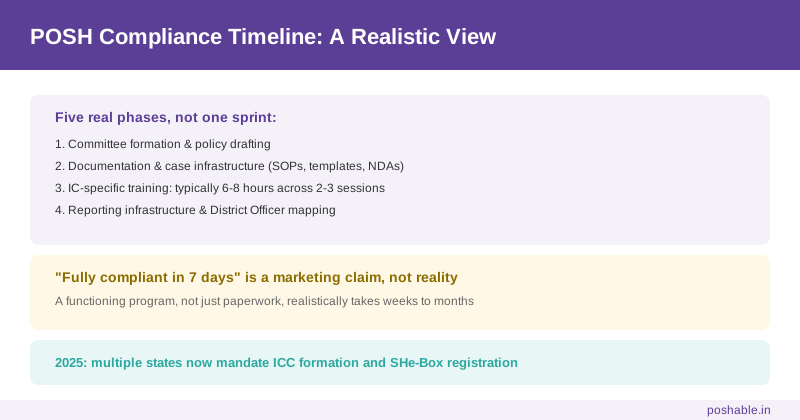
Any honest POSH compliance timeline starts with a warning: some websites promise full compliance in seven days. That claim technically isn’t a lie. You can generate a policy document and a committee order that fast. Whether any of it actually functions the first time a real complaint arrives is an entirely different question.
Moreover, understanding the real timeline, not the marketing one, helps you plan properly instead of discovering the gaps later, usually at the worst possible moment.
What You’ll Learn in This Guide
This article covers:
- Why fast turnaround claims rarely mean genuine readiness
- The five real phases implementation actually moves through
- How long IC training realistically takes on its own
- What 2025’s state-level mandates changed about urgency
- What actually slows most organizations down
POSH Compliance Timeline: Why “7 Days” Is Almost Never the Real Answer
A policy document and a signed committee order can genuinely exist within a week. However, compliance isn’t a document. It’s a functioning system: a committee that actually knows the inquiry process, employees who’ve genuinely absorbed the training, and documentation that will hold up if challenged. Therefore, a seven-day timeline usually describes paperwork completion, not organizational readiness.
Phase One: Committee Formation and Policy Drafting
This phase covers constituting or reconstituting the Internal Committee under the POSH Act, 2013, appointing a properly documented external member, issuing the formal constitution order, and drafting a policy that actually reflects your organization’s structure. Realistically, sourcing a genuinely qualified external member alone can take longer than most timelines allow for.
Phase Two: Documentation and Case Infrastructure
Before any case ever arrives, a functioning program needs standard operating procedures, complaint acknowledgment templates, respondent notice formats, witness invitation letters, interim relief memos, and confidentiality agreements ready to use. Consequently, building this infrastructure properly, rather than grabbing generic templates off the internet, takes real time upfront.
POSH Compliance Timeline: Training Takes Longer Than Most Budget For
Comprehensive Internal Committee training typically spans six to eight hours, delivered across two or three separate sessions, covering legal frameworks, investigation technique, confidentiality protocols, and documentation standards. This sits well beyond a single afternoon session, and general employee awareness training needs scheduling on top of that separately.
Phase Four: Reporting Infrastructure and Deadlines
This phase means mapping your correct District Officer, preparing the annual report format in advance, and scheduling awareness activities across the year rather than cramming them before a deadline. Organizations that skip this step usually scramble to reconstruct it later, right when the filing deadline actually arrives.
Phase Five: Making It Actually Function, Not Just Exist
The final phase covers launching a genuinely accessible reporting channel, auditing whether signage and policy access actually work in practice, testing how an escalation would really unfold, and scheduling quarterly committee reviews. Therefore, this is the phase most rushed implementations skip entirely, and it’s exactly the phase that determines whether the program works when it’s actually tested.
A Realistic Range, Start to Genuinely Functional
Basic paperwork can realistically finish within one to two weeks for a straightforward, single-location organization. However, a genuinely functioning program, trained committee, tested processes, and real documentation discipline included, more honestly takes several weeks to a few months, depending on organizational size and complexity.
POSH Compliance Timeline: Why 2025’s State Mandates Changed the Urgency
In 2025, multiple states, including Tamil Nadu, Karnataka, Maharashtra, Uttar Pradesh, Andhra Pradesh, and Telangana, issued their own notifications requiring companies to form committees and conduct regular workshops. Separately, Delhi directed all public and private entities to register their committees on the government’s SHe-Box portal. Consequently, “we’ll get to it eventually” has become a considerably riskier posture than it was even a year earlier.
What Slows Implementation Down in Practice
Sourcing a qualified external member usually takes longer than anyone expects. Scheduling training across multiple locations adds real delay. Leadership approval for policy language can stall for weeks if nobody owns the decision. Therefore, the biggest timeline risk usually isn’t the vendor. It’s internal coordination nobody planned for in advance.
How to Actually Move Faster Without Cutting Corners
Assign one internal owner from day one, rather than leaving decisions to committee. Confirm your external member early, since this step causes the most delay. Run committee and employee training as parallel tracks instead of sequential ones wherever your resources allow. If a compliance partner promises an unusually fast timeline without explaining exactly how, treat that the same way you’d treat unusually vague pricing: as a question worth pushing on, not a reason for confidence.
Conclusion: POSH Compliance Timeline Is a Process, Not a Sprint
In conclusion, a genuine POSH compliance timeline runs in phases, not a single sprint to a finish line. Moreover, 2025’s wave of state-level mandates has made moving deliberately, rather than not moving at all, the real priority now. Therefore, the honest goal isn’t finishing fastest. It’s building something that actually works the first time it’s tested. Request a demo today and we’ll map out a realistic timeline for your organization specifically, not a marketing one.