
Does POSH apply to lawyers? A profession built entirely around advocating for other people’s legal rights turns out to have a real gap in its own. In July 2025, a High Court ruled that the very law meant to protect women at work does not, in fact, cover women lawyers complaining against their own profession’s governing body.
Moreover, that ruling did not go unanswered for long. Within months, it landed before the Supreme Court itself. Therefore, whether POSH applies to lawyers is currently one of the most closely watched open questions in Indian employment law.
Request a demo today to see how our POSH compliance solutions can help your organization stay compliant and build a safer workplace.
What You’ll Learn in This Guide
This article covers:
- What the Bombay High Court actually ruled, and why
- The alternative remedy the Court pointed to instead
- Why women lawyers say that alternative falls short
- The Supreme Court challenge now underway
- What this means for law firms and chambers right now
Does POSH Apply to Lawyers? A Question the Courts Are Actively Deciding
This is not a settled question with one clear answer. A High Court has ruled one way. The Supreme Court is actively reviewing that ruling. Therefore, anyone citing a definitive answer either way is getting ahead of where the law currently stands.
The Bombay High Court’s July 2025 Ruling
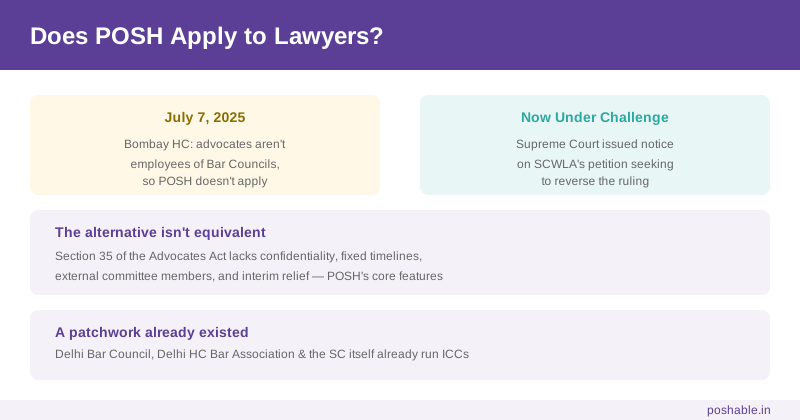
In UNS Women Legal Association v. Bar Council of India (2025), the Bombay High Court refused to direct Bar Councils to constitute permanent Internal Committees for advocates. It held that the POSH Act, 2013 generally requires an employer-employee relationship, and advocates simply do not stand in that relationship with the Bar Council.
Why the Court Said No: The Employer-Employee Test
The Court’s reasoning tracked Sections 2(f) and 2(g) of the Act, which define “employee” and “employer.” Advocates practice as independent professionals rather than as employees of any Bar Council. Consequently, the Court found no legal basis to extend POSH’s committee mechanism to complaints between advocates.
Does POSH Apply to Lawyers: The Alternative the Court Pointed To
The Bombay High Court did not leave women advocates without any remedy at all. It pointed to Section 35 of the Advocates Act, 1961, which lets Bar Councils take disciplinary action against advocates for professional or other misconduct, including conduct amounting to harassment.
Why Women Lawyers Say Section 35 Isn’t Enough
The Supreme Court Women Lawyers Association argues this alternative genuinely falls short. Section 35 lacks POSH’s specific protections: confidentiality guarantees, fixed inquiry timelines, mandatory external committee membership, and interim relief or compensation provisions. Moreover, Section 35 addresses general misconduct broadly. It was never designed to specifically address sexual harassment as its own category of wrong.
The Supreme Court Challenge Now Underway
SCWLA filed a Special Leave Petition challenging the Bombay High Court’s ruling. A Bench of Justices B.V. Nagarathna and R. Mahadevan issued notice on the petition, seeking responses from the Bar Council of India, the Bar Council of Maharashtra and Goa, and the Union of India. As a result, this question now sits squarely before the country’s highest court, with no final answer yet.
A Patchwork That Existed Even Before This Ruling
Even before the Bombay High Court’s decision, practice across India was already inconsistent. The Bar Council of Delhi, the Delhi High Court Bar Association, and the Supreme Court of India itself, through its own 2013 regulations, had already established Internal Committees for advocates. Therefore, this ruling did not create the inconsistency. It simply exposed how unevenly the legal profession had already been applying protections to its own members.
Does POSH Apply to Lawyers: What This Means Right Now
Until the Supreme Court resolves this, the practical answer depends heavily on where a lawyer practices and which body she is complaining against. A woman advocate in Delhi may have access to an Internal Committee her counterpart elsewhere does not. This is exactly the kind of inconsistency the pending case aims to settle.
What Law Firms and Chambers Should Do Regardless
This uncertainty concerns Bar Councils and Bar Associations specifically, not law firms as employers. A law firm employing associates and staff remains squarely covered by POSH regardless of how this litigation resolves, since a genuine employer-employee relationship already exists there. Therefore, firms should not read this case as license to relax their own compliance.
POSH Compliance Services for the Legal Profession
Many law firms and chambers bring in POSH compliance services specifically because the legal profession’s own structure, partners, associates, interns, and independent counsel, creates genuinely complicated questions about who counts as an employee. Getting this right internally matters regardless of how the broader Bar Council question eventually resolves.
Request a demo today to see how our POSH compliance solutions can help your organization stay compliant and build a safer workplace.
Conclusion: Does POSH Apply to Lawyers? The Answer Is Still Being Written
In conclusion, whether POSH applies to lawyers remains a genuinely open question, not a settled one. Moreover, the gap between a High Court ruling and a Supreme Court review shows exactly how contested this issue still is, even within the profession most familiar with the law itself. Therefore, anyone advising on this question today needs to track the Supreme Court proceeding closely, rather than treating the Bombay High Court’s ruling as the final word.
Request a demo today and discover how our expert-led POSH compliance services can help your organization stay compliant, reduce risk, and build a safer workplace.