
POSH in universities looks different from POSH in a corporate office. A university campus is a workplace for its faculty and staff. It is also something the POSH Act was never really written for: a place where thousands of students, who are neither employees nor visitors in the ordinary sense, spend most of their day. This gap is exactly why a second regulatory layer exists specifically for higher education.
Moreover, treating POSH in universities as identical to POSH in a corporate office misses real structural differences most institutions only discover the hard way. Therefore, understanding UGC’s own regulations matters just as much as understanding the Act itself, if your organization runs any kind of higher education institution.
Request a demo today to see how our POSH compliance solutions can help your organization stay compliant and build a safer workplace.
What You’ll Learn in This Guide
This article covers:
- Why a separate UGC regulation exists alongside the POSH Act
- Who these rules actually protect, beyond employees
- How the required committee structure genuinely differs
- Interim relief and student punishments the corporate Act doesn’t cover
- UGC’s own escalating consequences for non-compliance
POSH in Universities: A Parallel Regulatory Track Most People Miss
Higher education institutions answer to two frameworks at once. The first is the POSH Act itself. The second is the University Grants Commission (Prevention, Prohibition and Redressal of Sexual Harassment of Women Employees and Students in Higher Educational Institutions) Regulations, 2015. Consequently, a college that only reads the main Act is working from an incomplete rulebook.
The Legal Basis: UGC Regulations, 2015, Not Just the POSH Act
The UGC notified these regulations on May 2, 2016, under its own statutory powers, specifically to complement the POSH Act, 2013 in the higher education context. They apply to every UGC-recognized university, college, and deemed university in India, layered directly on top of standard POSH obligations rather than replacing them.
Who UGC Rules Actually Protect: Students, Not Just Employees
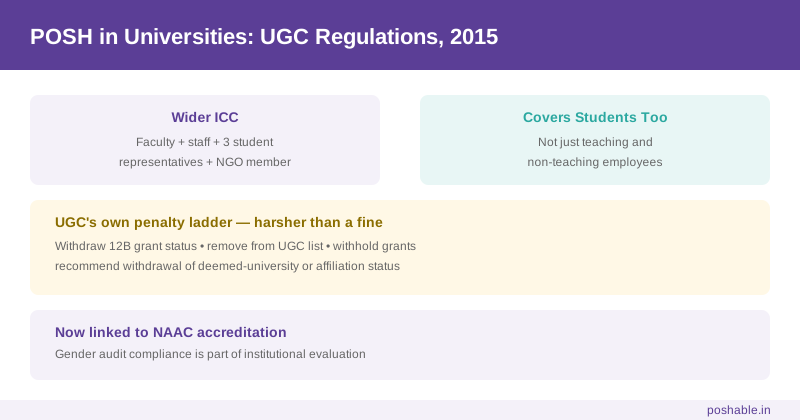
This is the single biggest structural difference. The regulations explicitly cover female students alongside teaching and non-teaching staff. This is a population the core POSH Act was never designed to include. Therefore, an institution’s Internal Complaints Committee has to function as a genuine student-facing body, not simply an HR mechanism dressed up for a campus.
POSH in Universities: A Very Different ICC Structure
A typical UGC-compliant committee includes a senior woman faculty member as Presiding Officer, two additional faculty members, and two non-teaching employees. It also includes three student representatives and one external member from an NGO or with relevant expertise. This is a considerably larger and more varied body than the four-member minimum a standard corporate committee needs.
Interim Relief That Goes Further Than the Corporate Version
Like the standard Section 12 interim relief provisions, UGC rules allow transfer, leave, and restrictions on evaluating the complainant’s work. However, campuses can go further. Where there is a genuine threat, the institution can restrict the respondent’s entry into the campus altogether. This remedy has no real equivalent in a typical office setting.
What Happens to a Student Found Guilty
Employees found responsible face action under service rules, much like any other POSH case. Students face an entirely different consequence structure: loss of library access, hostel privileges, transport, scholarships, or identity card access. In severe cases, this can extend to suspension or expulsion. Therefore, committees need real familiarity with student disciplinary processes, not just employment law.
POSH in Universities: UGC’s Own Escalating Penalty Ladder
Where a corporate employer faces a comparatively modest fine for non-compliance, UGC can act directly against the institution itself. This can include withdrawing an institution’s eligibility for grants, removing it from the Commission’s recognized list, and withholding already-sanctioned funds. In serious or repeated cases, UGC can go further and recommend withdrawal of deemed-university or affiliation status entirely. Consequently, non-compliance carries existential stakes for an institution in a way ordinary POSH penalties simply don’t.
The Growing Link to NAAC Accreditation
Gender-related compliance, including POSH readiness, increasingly factors into the National Assessment and Accreditation Council’s institutional evaluation process. As a result, weak POSH compliance no longer just risks a UGC penalty. It can quietly undermine an institution’s accreditation standing too.
Half-Yearly Reviews, Not Just Annual Reports
Unlike the standard annual reporting cycle most workplaces follow, UGC expects institutions to review their anti-harassment policy’s effectiveness every six months, not once a year. This shorter cycle reflects how quickly a student population, and the risks around it, can shift within a single academic year.
Practical Checklist for Higher Education Institutions
- Confirm the Internal Committee includes student representatives, not just staff
- Build a genuinely student-accessible complaint channel, publicized where students actually look
- Prepare separate disciplinary tracks for employee and student respondents
- Schedule policy effectiveness reviews every six months, not once a year
POSH Compliance Services for Campuses
Many higher education institutions bring in POSH compliance services specifically because campus compliance genuinely differs from corporate compliance, not just in scale but in structure. Getting this right protects both students and the institution’s own standing with UGC and accreditation bodies alike.
Request a demo today to see how our POSH compliance solutions can help your organization stay compliant and build a safer workplace.
Conclusion: POSH in Universities Answers to Two Regulators, Not One
In conclusion, POSH in universities means meeting the standard Act’s requirements while also satisfying a distinct, more demanding regulatory layer built specifically for campuses. Moreover, UGC’s own enforcement powers, and the growing NAAC accreditation link, give institutions a genuine reason to take this second layer as seriously as the POSH Act itself. Therefore, treating campus compliance as identical to corporate compliance is exactly the assumption that leaves institutions exposed.
Request a demo today and discover how our expert-led POSH compliance services can help your organization stay compliant, reduce risk, and build a safer workplace.