
The rights of the respondent get far less attention than the complainant’s protections in most POSH content, including much of what we cover here. That focus is correct. However, the Act also builds in rights for the person accused, and understanding them matters just as much for anyone actually running an inquiry.
Moreover, some of these rights are genuinely settled law. Others remain contested, even at the level of the Supreme Court. Therefore, a fair account of the rights of the respondent needs to be honest about which is which, rather than presenting the accused’s position as either fully protected or entirely at the committee’s mercy.
Request a demo today to see how our POSH compliance solutions can help your organization stay compliant and build a safer workplace.
What You’ll Learn in This Guide
This article covers:
- What the respondent is legally entitled to know, and when
- The right to present evidence and call witnesses
- Why cross-examination remains genuinely contested territory
- What the Supreme Court actually ordered in 2010
- Where confidentiality cannot be used to deny a fair defence
Rights of the Respondent: A Question Most POSH Content Skips
Under Section 2(m) of the Act, a respondent is simply the person an aggrieved woman has complained against. A complaint against him does not strip away his own procedural protections. The POSH Act, 2013 builds fairness into the process for both parties, not just the complainant.
The Right to Know the Complaint, In Full
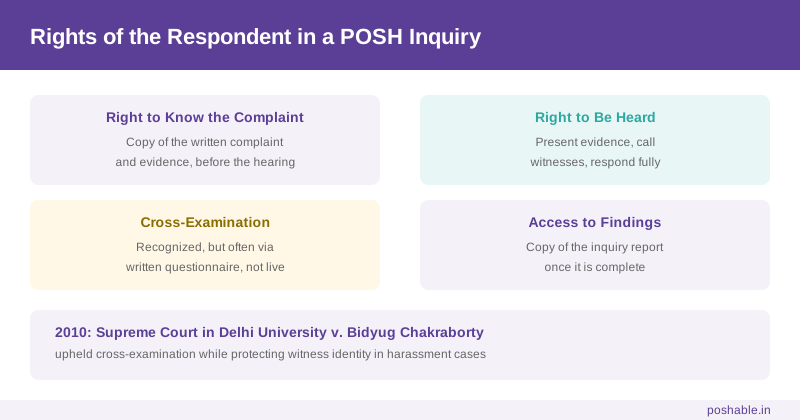
Rule 3 of the POSH Rules gives the respondent the right to know exactly what accusation he faces. He must receive a copy of the written complaint and any supporting documents before the committee calls him in for a hearing. Consequently, an inquiry that springs allegations on someone without prior notice already stands on shaky procedural ground.
The Right to Be Heard, Not Just Notified
Sections 11 and 13 guarantee both parties an equal chance to present their side. This traces back to the constitutional principle of audi alteram partem, hear the other side, which draws on Articles 14 and 21. Therefore, simply informing the respondent of the charge is not enough. He must have a genuine chance to respond to it.
Rights of the Respondent: Presenting Evidence and Witnesses
The respondent can produce his own evidence and bring witnesses in his defence, and the Internal Committee must give this a genuine opportunity, not just a procedural formality. However, exactly how far this extends into cross-examining the complainant and her witnesses is where the law gets genuinely complicated.
The Cross-Examination Question Courts Still Debate
Legal commentary is refreshingly honest about this: having a chance to speak is not automatically the same as having the right to cross-examine. Some High Courts have required only written questions submitted to the committee, not live confrontation. Others have found that written questions alone fail to meet natural justice standards. As a result, this remains one of the least settled questions in POSH jurisprudence.
What the Supreme Court Actually Ordered in 2010
In Delhi University & Anr. v. Bidyug Chakraborty & Ors. (2010), the Supreme Court held that the respondent could demand a hearing and cross-examine the witnesses. However, because the case involved sexual harassment, the Court also ordered that the committee need not reveal witness identities. Instead, the respondent could submit written questions for the witnesses to answer.
This single order still shapes how many committees handle cross-examination today: a real right, but one committees can exercise through a questionnaire rather than a face-to-face confrontation, specifically to protect witnesses in sensitive cases.
Confidentiality Cannot Become a Shield Against Fair Defence
Employers sometimes worry that POSH confidentiality requirements conflict with a respondent’s need to see the evidence against him. Courts have consistently rejected that reading. A respondent facing disciplinary consequences has a right to the material he needs to mount a genuine defence, and confidentiality obligations exist to protect identities, not to deny due process altogether.
Rights of the Respondent: What the Act Does Not Promise
The Act does not promise a criminal-trial standard of proof, formal legal representation as of right, or a guarantee that the committee will never consider past conduct. Some courts have allowed a respondent’s prior behaviour to inform the committee’s assessment. Therefore, respondents should understand this process resembles a domestic inquiry far more than a courtroom trial.
Practical Checklist for Respondents Facing an Inquiry
- Request a full copy of the written complaint and any supporting evidence before your hearing
- Prepare your own evidence and identify witnesses who can support your account
- Ask directly how the committee will handle cross-examination, since practice varies by organization
- Understand you are entitled to see the committee’s final findings once the inquiry concludes
What This Means for Committees Running the Inquiry
A committee that skips these protections is not just being unfair to the respondent. It is building an outcome vulnerable to appeal on exactly this ground. Therefore, following these procedural rights carefully protects the integrity of the entire process, including for the complainant whose case might otherwise unravel later.
Request a demo today to see how our POSH compliance solutions can help your organization stay compliant and build a safer workplace.
POSH Compliance Services for Balanced, Defensible Inquiries
Many organizations bring in POSH compliance services specifically to train committees on this balance: taking the complainant’s account seriously while still protecting the respondent’s genuine procedural rights. Getting both right is what makes an inquiry’s findings actually hold up if challenged.
Conclusion: Rights of the Respondent Protect the Process Itself
In conclusion, the rights of the respondent are not a loophole or a distraction from the Act’s core purpose. Moreover, as the Bidyug Chakraborty case shows, even the Supreme Court has had to carefully balance fairness to the accused against protection for witnesses, rather than picking one side outright. Therefore, committees that take both sets of rights seriously produce findings far more likely to survive scrutiny, whichever way the outcome ultimately goes.
Request a demo today and discover how our expert-led POSH compliance services can help your organization stay compliant, reduce risk, and build a safer workplace.