
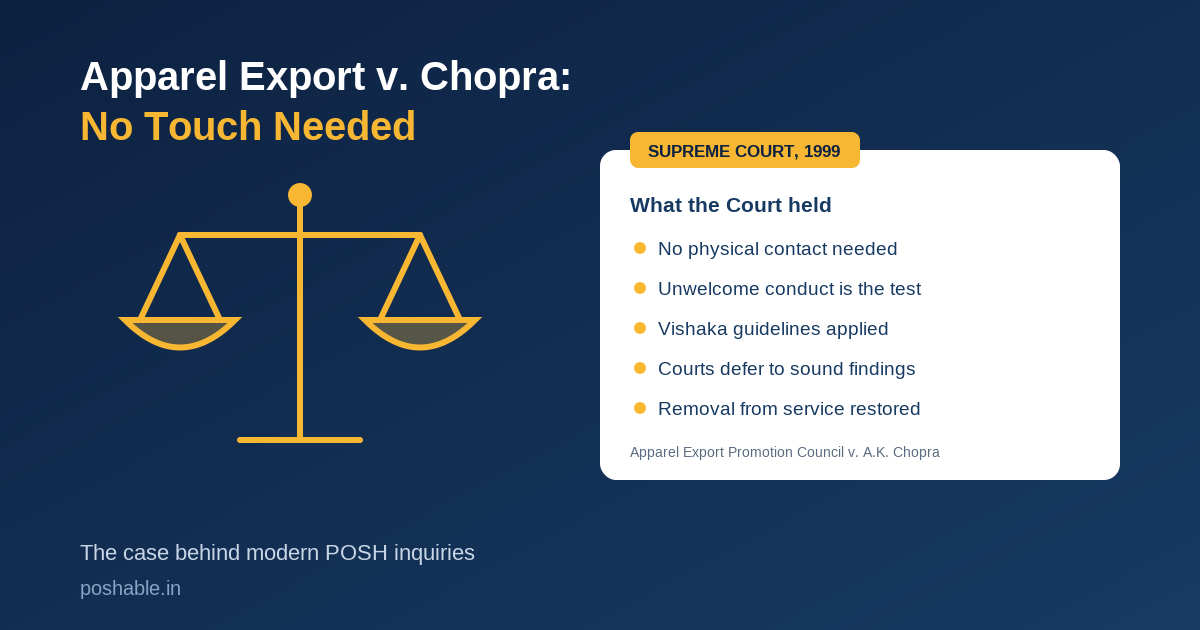
Apparel Export Promotion Council v. Chopra is the Supreme Court case every Internal Committee should know. Decided in 1999, it settled that sexual harassment does not need physical contact. It also told courts to respect well-supported disciplinary findings. Together, both points still shape POSH inquiries today.
Apparel Export Promotion Council v. Chopra: The Facts
A.K. Chopra was a Private Secretary to the Chairman of the Council. The complainant was a clerk-cum-typist who had not been trained in dictation. In August 1988, he pressed her to go with him to a hotel business centre. There he repeatedly sat close to her and tried to touch her despite her objections. She complained within days. As a result, the Council suspended him, held an inquiry and removed him from service in 1989.
A Single Judge of the Delhi High Court found that he had tried to molest her but had not actually molested her. He ordered reinstatement without back wages. A Division Bench agreed, reasoning that without physical contact there was no attempt to molest. The Council then appealed.
Apparel Export Promotion Council v. Chopra: What the Supreme Court Held
First, the Supreme Court held that actual physical contact is not required. Conduct that falls short of touching can still be sexual harassment. Moreover, the Court said the High Court had wrongly used the meaning of molestation from a criminal trial.
Relying on the Vishaka guidelines of 1997, the Court treated sexual harassment as unwelcome, sexually determined behaviour, whether direct or implied. It also grounded this in the constitutional rights to equality and to life and liberty. It referred as well to international instruments such as CEDAW.
The Court restored the removal from service. It found the complainant’s evidence credible and said courts should look at the broader probabilities, not minor discrepancies. In addition, it called for great sensitivity in these cases. A late apology did not help the respondent.
How Far Courts Can Interfere With Findings
The Court also set a limit on judicial review. The disciplinary authority is the fact-finder. A High Court should interfere only if the findings rest on no evidence, are perverse or legally untenable, or the procedure was flawed. Likewise, it should interfere with the punishment only if the penalty is impermissible or shocks its conscience. So a well-documented inquiry carries real weight.
The Apparel Export Promotion Council Ruling and the POSH Act
The POSH Act of 2013 later codified the idea. Section 2(n) lists unwelcome physical contact and advances, sexually coloured remarks and any other unwelcome verbal or non-verbal conduct of a sexual nature. Therefore conduct need not involve touching to fall within it. Our guide to unwelcome conduct explains intent versus impact.
Apparel Export Promotion Council Lessons for Employers
- Judge the conduct by whether it was unwelcome, not by whether touching occurred.
- Record each witness statement and the reasons for the findings in writing.
- Test the complainant’s evidence on overall probability, not on small discrepancies.
- Treat seniority as no reason for leniency in the penalty.
- Train committee members on the 1999 ruling and Section 2(n).
Common Mistakes to Avoid
- Dismissing a complaint because there was no physical contact.
- Reading the criminal law meaning of molestation into the inquiry.
- Giving heavy weight to small gaps in the complainant’s account.
- Showing mercy to a respondent because of his seniority.
- Leaving findings without written reasons.
Using the Case in Your Inquiry
Therefore committees can apply these principles through the steps in our guide to the inquiry process. Penalties should then follow our disciplinary action guide. Respondents also keep their rights in an inquiry, so fairness runs both ways.
Build the Ruling Into Committee Training
Apparel Export Promotion Council v. Chopra deserves a place in your committee handbook. First, add a short case note covering the facts, the no-contact point and the review standard. Moreover, refresh it at each annual training. A committee that knows the case is less likely to dismiss a valid complaint.
This post summarises the judgment in general terms, so read the full judgment for its exact wording. If you want help training your committee, Request a demo today and our team will walk you through it.