
POSH compensation is not a fine, and it is not automatic. It is a sum the committee may recommend only after it finds the allegation proved. Section 15 tells the committee what to weigh, but the Act fixes no amount. A mid-2026 Madhya Pradesh High Court ruling also shows that a large award can unravel while an appeal is pending.
When POSH Compensation Can Be Recommended
Compensation sits in Section 13(3)(ii). The committee reaches it only when the inquiry proves the allegation. It may then recommend that the employer deduct a sum from the respondent’s salary or wages, notwithstanding anything in the service rules. The sum goes to the aggrieved woman or, as the committee determines, to her legal heirs.
Section 13(3)(i) is a separate track. That clause covers action for misconduct under the service rules, and our guide to disciplinary action after a guilty finding explains it. Conciliation works differently. Section 10 bars any monetary settlement as the basis of conciliation, so money can never buy the closure of a complaint. Our post on conciliation under Section 10 covers that rule.
The Five Factors Under Section 15
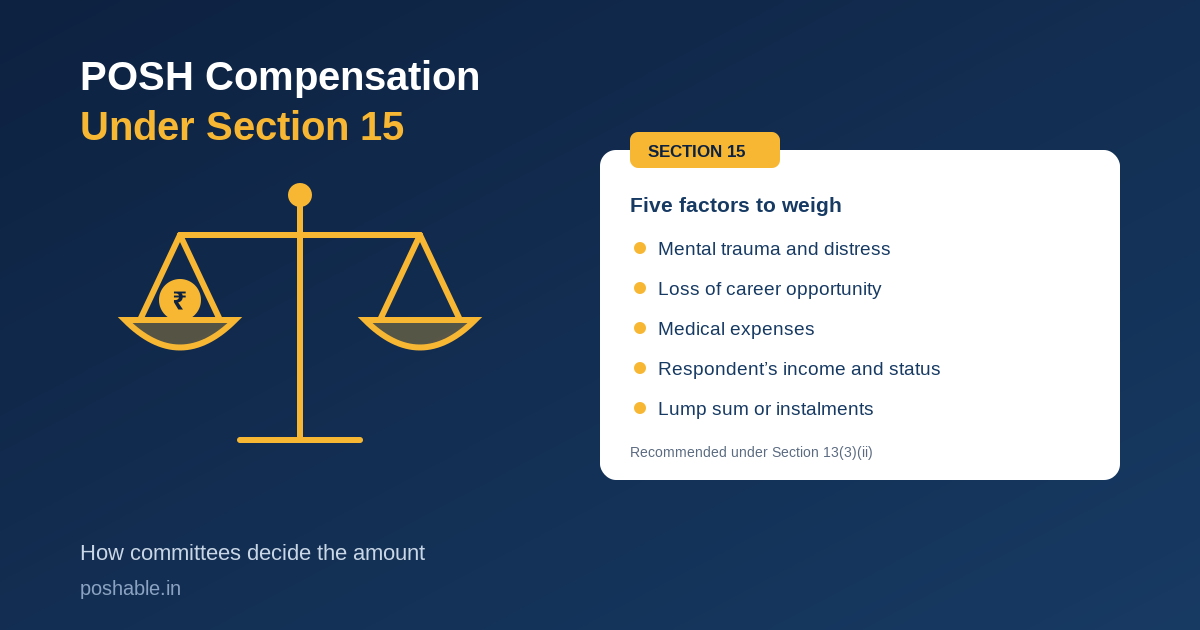
Section 15 says the committee shall have regard to five things when it decides the sum.
- Mental trauma, pain, suffering and emotional distress caused to the aggrieved woman.
- Loss in career opportunity due to the harassment.
- Medical expenses incurred for physical or psychiatric treatment.
- The income and financial status of the respondent.
- Whether payment is feasible in a lump sum or in instalments.
Neither Section 13 nor Section 15 sets a minimum or a maximum. Section 13(3)(ii) leaves the sum to what the committee considers appropriate. That freedom makes written reasons important, because a respondent can challenge a figure that has no recorded basis.
What Happens When the Respondent Does Not Pay
Payment follows a set order. First, the employer deducts the sum from salary. If the respondent is absent from duty or has left the job, the employer may direct him to pay the aggrieved woman directly. If he still does not pay, the committee may forward its order to the District Officer for recovery as an arrear of land revenue. Under Section 13(4), the employer or District Officer must act on the recommendation within sixty days of receiving it.
Why a Pending Appeal Can Stall POSH Compensation
Section 18 lets an aggrieved person appeal a recommendation under Section 13(3)(ii). The appeal must come within ninety days of the recommendation. It follows the service rules, or the prescribed procedure where no service rules apply.
A 2026 judgment shows why this matters. In Dilip Kumar Dureha v. Anusha Deepak Tyagi (Writ Appeal No. 2332 of 2025), a yoga instructor at a national physical education institute had complained against its Vice-Chancellor. A single judge awarded her ₹35 lakh against him. A Division Bench of the Madhya Pradesh High Court, Gwalior Bench, set that order aside. His statutory appeal was still pending, and the bench held that the right of appeal is a substantive right. It sent the matter back to the appellate authority. You can read the LiveLaw report of the ruling.
That award came from a writ court, not from the committee. Even so, the practical lesson holds. Check whether an appeal is pending before you enforce a compensation recommendation, and take legal advice on the timing.
What This Means for Employers
- Record how the committee weighed each of the five factors.
- Ask the aggrieved woman for evidence of medical expenses and career impact.
- Check the respondent’s employment status before choosing a recovery route.
- Diarise the sixty-day deadline under Section 13(4).
- Confirm whether an appeal is pending before you enforce the recommendation.
Common Mistakes With POSH Compensation
- Offering money to end a complaint, which Section 10 forbids as the basis of conciliation.
- Recommending a figure without recording reasons under Section 15.
- Ignoring the respondent’s income and ability to pay.
- Missing the sixty-day deadline for acting on the recommendation.
- Forgetting that the respondent may appeal within ninety days.
For the stages that lead to a finding, see our guide to the Internal Committee inquiry process. Respondents keep important procedural protections throughout, and our guide to the rights of the respondent covers them.
Building Compensation Steps Into Your POSH Policy
Your policy should say how the committee records its reasoning on each Section 15 factor. It should set out the order of recovery and the sixty-day deadline. It should also note that an appeal may delay payment. Written steps protect the aggrieved woman and the employer alike.
Need help setting these steps out or training your committee? Request a demo today and our team will walk you through it.