
Most POSH compliance work happens once, at setup: constitute the committee, write the policy, run the training. However, one obligation repeats every single year, and it is the one regulators increasingly check first. The POSH annual report is not a formality anymore.
Moreover, since 2023 the Supreme Court has kept a watchful eye on exactly this filing, pushing District Officers to actively collect it rather than simply wait for employers to remember. Therefore, treating this as an afterthought is a riskier bet than it used to be.
Request a demo today to see how our POSH compliance solutions can help your organization stay compliant and build a safer workplace.
What You’ll Learn in This Guide
This article covers:
- The two separate filings the Act actually requires
- What must go into the report, even in a year with zero complaints
- Where and when to file it
- Why courts are now watching this more closely than ever
- Penalties for skipping it
POSH Annual Report: Two Separate Filings You Cannot Skip
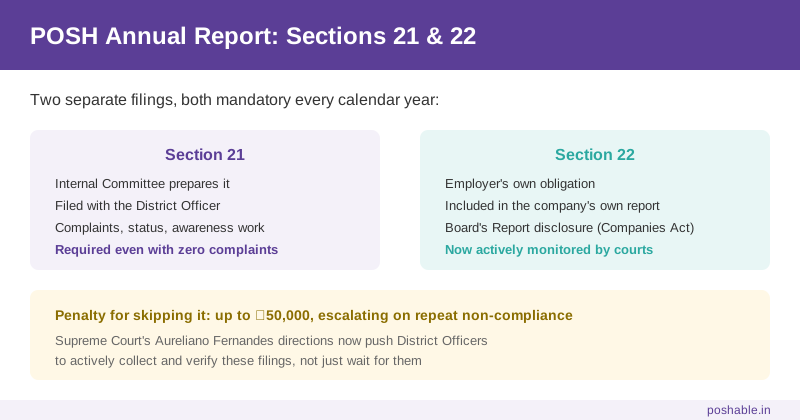
Under Section 21 of the POSH Act, 2013, the Internal Committee must prepare an annual report every calendar year and submit it to both the employer and the District Officer. Separately, Section 22 requires the employer to fold this same information into the organization’s own annual report, which for companies means disclosure in the Board’s Report under the Companies Act, 2013.
What Section 21 Actually Requires the Committee to Prepare
The Internal Committee, typically through its Presiding Officer, compiles the year’s data and drafts the report. It then goes first to the employer, who forwards it to the District Officer for the district where the workplace sits.
What Section 22 Adds for the Employer
The employer’s obligation does not end at forwarding the IC’s report. Companies governed by the Companies Act must separately confirm, in their own Board’s Report, that they have complied with the POSH Act’s committee constitution and reporting requirements. Moreover, recent Ministry of Corporate Affairs updates have pushed this from a routine line item into something boards must now actively verify. Simply signing off is no longer enough.
Filing This Even When There Are Zero Complaints
A year with no complaints still requires a report. The filing should simply confirm that the committee was properly constituted, that no complaints came in, and what awareness or training activities took place regardless. Skipping the report because “there was nothing to report” is itself a compliance gap.
What the POSH Annual Report Must Actually Contain
A complete filing typically includes:
- The number of complaints received during the calendar year
- How many were resolved, and how many remain pending
- Awareness programs and training conducted for the committee and employees
- Confirmation of the committee’s current composition
- Any recommendations for improving workplace safety going forward
Moreover, this data should never include names or identifying details of complainants, respondents, or witnesses. This stays consistent with the confidentiality obligations that apply throughout the process.
Where and When to File
The report covers the calendar year and is generally expected by January 31 of the following year, though exact routing varies by state. Most districts accept submission through the Labour Department or the office of the District Magistrate, either physically or by email. Consequently, keeping a stamped or emailed acknowledgment of submission matters just as much as filing the report itself.
Why Courts Are Now Watching This Closely
In Aureliano Fernandes v. State of Goa (2023), the Supreme Court set aside a university’s inquiry for violating natural justice, but the case did not end there. The Court kept supervising implementation afterward. It ordered states to appoint District Officers, form Local Committees, and run nationwide surveys checking whether Internal Committees even exist. The Court specifically directed District Officers to actively collect Section 21 annual reports rather than treat them as optional paperwork.
As a result, “nobody asked for it” is no longer a safe assumption for employers who have quietly skipped this filing for years.
Penalties for Skipping the POSH Annual Report
Non-filing exposes an organization to a fine of up to ₹50,000, with escalating consequences, including potential business license issues, on repeat non-compliance. Moreover, an incomplete or clearly inaccurate filing can attract the same scrutiny as not filing at all.
POSH Annual Report: Documentation Checklist Before You File
Before submitting, confirm:
- The committee’s composition is current and properly documented
- Complaint numbers match internal case records exactly
- Training and awareness records support every activity the report claims
- A copy of the filed report and its acknowledgment sit in your compliance file
Moreover, this is precisely the kind of record a POSH audit checks first, since a missing or inconsistent annual report is one of the fastest ways to fail one.
Common Mistakes Companies Make with This Filing
- Assuming zero complaints means no filing is needed
- Filing but keeping no proof of submission
- Letting the Board’s Report disclosure fall out of sync with what the IC actually reported
- Treating this as a one-person task rather than a shared HR and legal responsibility
Request a demo today to see how our POSH compliance solutions can help your organization stay compliant and build a safer workplace.
POSH Compliance Services for Annual Filing
Many organizations bring in POSH compliance services specifically to keep this filing on schedule and consistent with everything else the committee has documented across the year. This matters more now that both courts and boards are paying closer attention than they once did.
Conclusion: The POSH Annual Report Is No Longer a Formality
In conclusion, the POSH annual report used to be the kind of filing only a careful compliance officer remembered. Moreover, Aureliano Fernandes changed that calculus by putting active judicial supervision behind Section 21 enforcement. Therefore, every organization, regardless of size, should treat this yearly filing with the same seriousness as constituting the committee in the first place.
Request a demo today and discover how our expert-led POSH compliance services can help your organization stay compliant, reduce risk, and build a safer workplace.