
Most POSH compliance failures do not start with a bad inquiry. They start earlier, with a POSH Internal Committee composition that was never valid in the first place. Therefore, before any complaint ever arrives, organizations need to get the committee itself right.
Moreover, an improperly constituted committee is not just a paperwork problem. As a result, a court can set aside its findings entirely, forcing organizations to restart a painful process from scratch. However, many companies still treat committee formation as a one-time box to tick rather than an ongoing compliance obligation. Therefore, understanding exactly who must sit on the committee, and why, is essential POSH compliance India work.
Request a demo today to see how our POSH compliance solutions can help your organization stay compliant and build a safer workplace.
What You’ll Learn in This Guide
This article covers:
- The minimum POSH Internal Committee composition required by law
- Who qualifies as Presiding Officer, employee members, and the external member
- The 50% women requirement and tenure limits
- What happens when composition gets challenged in court
- Documentation needed to prove a valid committee
POSH Internal Committee Composition: Why Getting It Wrong Is Costly
Consequently, an organization can run a textbook-perfect inquiry and still have the entire outcome unravel if the committee that conducted it was never validly constituted. Therefore, composition is not a formality — it is the foundation everything else in POSH compliance India rests on.
POSH Internal Committee Composition: Minimum Requirements Under Section 4
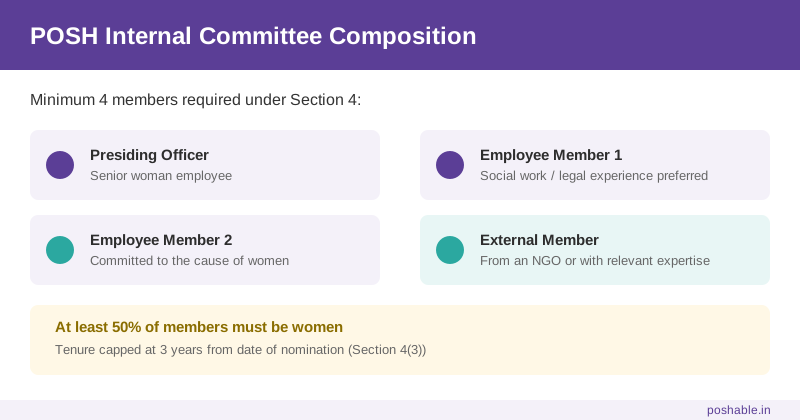
Under Section 4 of the POSH Act, 2013, every workplace with 10 or more employees must constitute an Internal Committee with a minimum of four members:
- A Presiding Officer
- At least two employee members
- One external member
Moreover, organizations with offices or administrative units at different locations must constitute a separate Internal Committee at each one — a single head-office committee does not automatically cover branch offices.
Presiding Officer Eligibility Under POSH Compliance India
The Presiding Officer must be a woman employed at a senior level at the workplace. However, the Act does not define “senior” with a precise designation or pay grade, which is exactly where many committees run into trouble. Therefore, the safest approach is choosing someone senior enough, relative to likely respondents, that her authority is not credibly questionable.
If no senior woman employee is available at that location, the employer must nominate one from another office or branch of the same organization.
Employee Members and the External Member Requirement
The two employee members should preferably be committed to the cause of women, or have experience in social work, or possess legal knowledge. Moreover, prioritizing employees who have actually completed POSH training strengthens the committee’s credibility considerably.
The external member, meanwhile, must come from an NGO or association committed to the cause of women, or be otherwise familiar with issues of sexual harassment. As a result, this member exists specifically to guard against internal bias and organizational pressure — and by law, the employer must pay this member a fee or allowance for participating in proceedings — a requirement many organizations overlook entirely.
POSH Internal Committee Composition: The 50% Women Rule
At least half of the total nominated members must be women. With a four-member committee, that means at least two members, including the Presiding Officer, must be women. Consequently, organizations that expand the committee to five or seven members to make quorum easier to reach must recalculate this ratio each time membership changes.
Tenure and Reconstitution of the Internal Committee
Every member, including the Presiding Officer and the external member, holds office for a period not exceeding three years from the date of nomination. Therefore, the three-year clock starts on the appointment letter date, not on the date of any particular inquiry.
Reconstitution becomes necessary when:
- The three-year term of existing members ends
- A member resigns, retires, or is disqualified
- The organization undergoes a merger or restructuring
- A new office location requires its own committee
Moreover, the Act permits reappointing the same members for another term, though many compliance practitioners recommend rotating at least some internal seats to keep the committee’s perspective fresh.
When Composition Gets Challenged: What Courts Have Said
Composition challenges are not theoretical. In Shital Prasad Sharma v. State of Rajasthan (2018), the petitioner challenged the validity of an Internal Committee. His argument: its Presiding Officer held a lower rank than he did, and other members were his subordinates. As a result, cases like this illustrate exactly why “senior enough” is not a box to tick lightly. A committee perceived as subordinate to the respondent invites exactly this kind of challenge.
Therefore, when constituting or reconstituting a committee, organizations should actively assess whether a senior respondent could plausibly challenge its composition, not only whether it satisfies the letter of Section 4.
Multiple Offices, Multiple Committees: A Common Compliance Gap
Organizations with several branches frequently assume one head-office committee is sufficient. However, this is incorrect. Consequently, growing companies should audit, at every expansion, whether new locations require their own Internal Committee — a gap our Internal Committee inquiry process guide assumes is already closed before an inquiry ever begins.
POSH Internal Committee Composition: Documentation Checklist
A defensible Internal Committee is a documented one. Records should include:
- A formal written order constituting the committee, naming every member and designation
- Appointment letters specifying tenure and, for the external member, any honorarium
- Proof of the external member’s NGO affiliation or relevant expertise
- Records confirming the 50% women requirement at the time of each nomination
Moreover, this is precisely the kind of documentation a POSH audit checks first, since a defective committee undermines every inquiry it has ever conducted.
Consequences of an Improperly Constituted Committee
Failing to constitute the committee correctly carries the same statutory penalties as failing to constitute one at all: a fine of up to ₹50,000 for a first offense, with higher penalties on repeat non-compliance. However, the more damaging consequence is often practical — every inquiry conducted by an invalid committee becomes vulnerable to challenge, potentially years after the fact.
Request a demo today to see how our POSH compliance solutions can help your organization stay compliant and build a safer workplace.
POSH Compliance Services for Committee Formation
Many organizations engage POSH compliance services specifically to source qualified external members, draft constitution orders correctly, and track tenure so reconstitution never lapses unnoticed. Moreover, this is often more cost-effective than discovering a composition defect only after someone has already filed a complaint.
Common Mistakes Companies Make with Committee Composition
- Appointing a Presiding Officer without checking relative seniority to likely respondents
- Forgetting the external member’s fee, which is a legal requirement, not a courtesy
- Letting tenure quietly lapse past three years without reconstitution
- Assuming one committee covers every branch office
Conclusion: POSH Internal Committee Composition Is Not a One-Time Task
In conclusion, POSH Internal Committee composition is a standing compliance obligation, not a checkbox completed once at incorporation. Moreover, as tenure expires, offices expand, and employees leave, organizations must actively track and reconstitute their committee rather than assume it remains valid indefinitely. Therefore, treating composition with the same seriousness as the inquiry process itself is essential POSH compliance India practice.
Request a demo today and discover how our expert-led POSH compliance services can help your organization stay compliant, reduce risk, and build a safer workplace.