
A complaint has landed with your Internal Committee. Now what?
Most POSH content online tells you what the law says. Very few walk through what the IC actually has to do, in order, once a complaint is filed. This guide covers the full inquiry process under the POSH Act, 2013 — from acknowledgment to appeal — with the statutory timelines your IC is legally bound to.
What Triggers an IC Inquiry
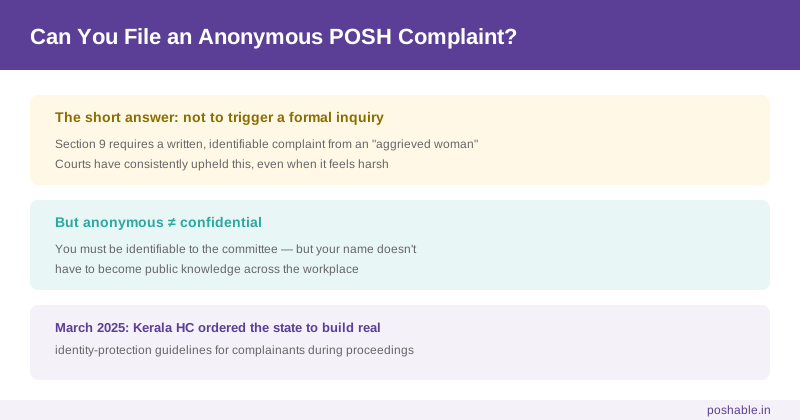
An inquiry begins the moment a written complaint of sexual harassment is received by the Internal Committee (IC) or Local Committee (LC). A complainant has three months from the date of the last incident to file, though the IC can condone a further three-month delay for sufficient recorded reason. Courts have taken this limitation seriously — the Supreme Court dismissed a complaint as time-barred in a 2025 ruling even where the underlying allegations were serious, so “we’ll consider it anyway” is not a safe default for a committee.
Step 1: Acknowledge and Send to the Respondent (7 Days)
Once a complaint is received, the IC sends a copy to the respondent within seven days. This starts the formal inquiry clock and gives the respondent the chance to reply.
Step 2: Offer Conciliation, If Requested
Before starting the inquiry, the IC must offer conciliation if the complainant requests it — but only to settle terms, never to negotiate money as the basis for settlement. If conciliation succeeds, the IC records the terms and no further inquiry is conducted. Most cases skip this step and proceed straight to inquiry.
Step 3: Conduct the Inquiry
This is where committees most often go wrong. The IC has powers similar to a civil court: summoning witnesses, calling for documents, recording statements. Both parties must be heard — this is a natural justice requirement, not optional courtesy. Practically, this means:
- Recording statements from both the complainant and respondent
- Reviewing documentary evidence — emails, chat logs, screenshots
- Interviewing witnesses where relevant
- Maintaining written minutes of every meeting
During this stage, the IC can also recommend interim relief — transferring either party, granting the complainant up to three months of additional leave, or restraining the respondent from supervising or reporting on the complainant’s work.
Step 4: Complete the Inquiry (90 Days)
Section 11(4) requires the IC to complete its inquiry within 90 days of the complaint being received. This is the deadline most organizations struggle to hit — voluminous evidence, witness unavailability, and inexperienced committees routinely push cases past it.
Here’s the part that surprises most HR teams: missing 90 days does not automatically invalidate the inquiry. The Delhi High Court confirmed this directly in a 2025 challenge, holding that the Act prescribes no penalty for breaching the timeline and that quashing a case on that basis alone would defeat the protective purpose of the law. That said, “no automatic invalidation” is not license to be careless — chronic delay is still a compliance red flag in audits and can be used to argue prejudice in specific cases.
Step 5: Submit the Report (10 Days)
Once the inquiry concludes, the IC has 10 days to submit its findings and recommendations to the employer.
Step 6: Employer Acts on Recommendations (60 Days)
The employer is legally required to act on the IC’s recommendations within 60 days of receiving the report — this can include disciplinary action, or dismissal of the complaint if unsubstantiated.
Step 7: The Right to Appeal (90 Days)
Either party who is dissatisfied with the outcome can appeal to a court or tribunal, within 90 days of the recommendation.
Timeline at a Glance
| Stage | Deadline |
|---|---|
| Complaint filed | Within 3 months of incident (+3 month extension possible) |
| Complaint sent to respondent | Within 7 days |
| Inquiry completed | Within 90 days |
| Report submitted to employer | Within 10 days of conclusion |
| Employer acts on recommendations | Within 60 days |
| Appeal window | Within 90 days of recommendation |
Common Mistakes ICs Make
- Rushing to conclusions instead of weighing corroboration and consistency
- Skipping written minutes, which weakens the inquiry if it’s ever challenged
- Treating the 90-day deadline as a hard cutoff — it’s a mandate to comply with, not a technicality to exploit
- Breaching confidentiality under Section 16, which is a separate compliance violation with its own consequences
FAQs
What happens if the IC doesn’t have four members as required?
An improperly constituted IC (fewer than four members, no external member, or under 50% women) can itself be grounds to challenge the inquiry’s validity — get the composition right before a complaint ever arrives.
Can the employer overrule the IC’s recommendation?
No. The IC’s findings function like a binding recommendation the employer must act on within 60 days, not a suggestion to weigh against other factors.
Is this the same as the audit process?
No — an audit checks whether your policy, IC, and records comply with the law overall. An inquiry is the case-specific process for one complaint.