
POSH conciliation sounds like a safe shortcut, but it closes less than most employers assume. Section 10 of the POSH Act lets the committee settle a complaint without a full inquiry. However, a settlement stops only the committee’s inquiry. It does not automatically stop your own disciplinary process. A January 2026 Gauhati High Court ruling makes that distinction explicit.
How POSH Conciliation Works Under Section 10
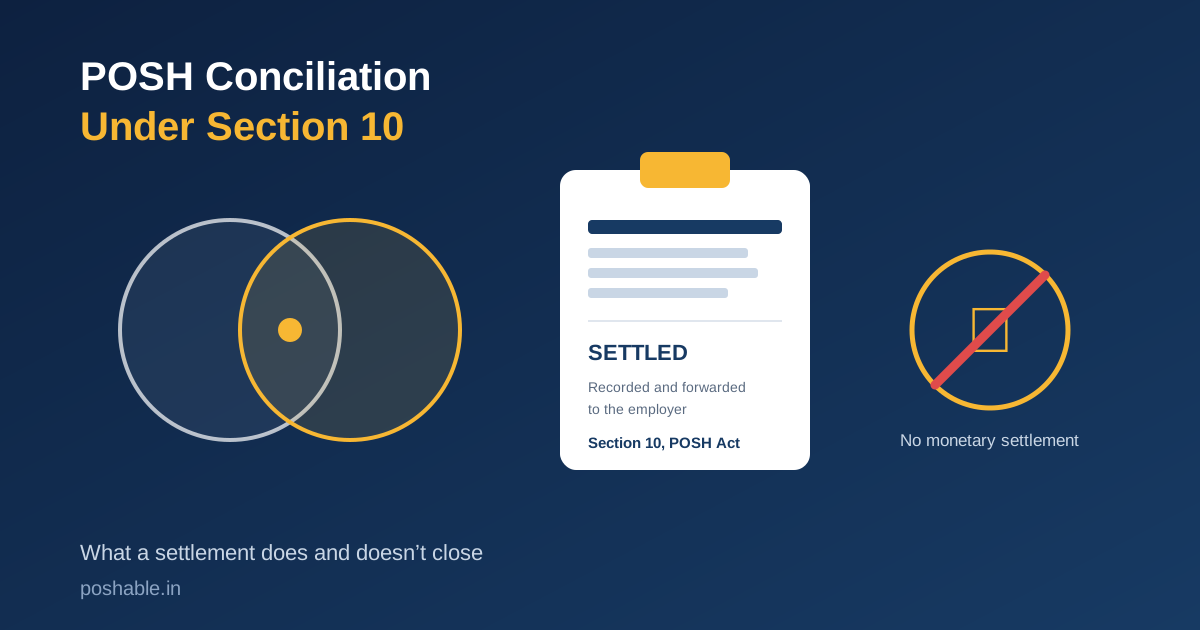
Section 10(1) lets the Internal Committee or Local Committee step in before it starts an inquiry under Section 11. It can do so only at the request of the aggrieved woman. The committee may then take steps to settle the matter between her and the respondent. The Act sets one firm limit: no monetary settlement can be the basis of conciliation.
Three duties follow once the parties settle. First, the committee records the settlement. Then it forwards that record to the employer, or to the District Officer in the case of a Local Committee, to act on it. Finally, it gives copies to both the aggrieved woman and the respondent. Under Section 10(4), no further inquiry follows. Our guide to the Local Complaints Committee explains when the Local Committee takes over from an Internal Committee.
Who Can Start Conciliation, and Who Cannot
The request must come from the complainant. The employer cannot ask for it, and the respondent cannot demand it. The committee should not nudge her towards it either. Section 10 says the committee “may” attempt conciliation, so the word is permissive rather than mandatory.
One court has read the provision differently. In Dr. Kali Charna Sabat v. Union of India (Writ Petition No. 10021 of 2024), a single judge of the Madhya Pradesh High Court held in November 2024 that the committee must attempt conciliation before it inquires. The case involved an assistant professor accused by female students. You can read the report of that decision on Verdictum. Critics argue that the statute ties conciliation to the complainant’s request. Until a larger bench settles the point, treat that ruling with care.
What the Gauhati High Court Decided
In Airports Authority of India v. Praveen VS (Writ Appeal No. 149 of 2025), a Division Bench of the Gauhati High Court examined what happens after a settlement. A subordinate had accused a senior officer. During the inquiry, both sides agreed to conciliation. The settlement asked them to keep a professional distance and involved no money. The committee then closed the matter. The employer later began its own disciplinary proceedings, and a single judge quashed them. The Division Bench reversed that order.
The bench held that Section 10(4) bars only further inquiry by the committee. It does not remove the employer’s power to inquire into misconduct under its service rules. The court also treated the POSH Act as a source of minimum protection rather than an exclusive remedy. The disciplinary proceedings were allowed to resume. The Verdictum report sets out the bench’s reasoning in full.
What This Means for Employers
A signed settlement is not a clean closure. If your service rules allow separate action, the employer may still use them. Even so, a separate process needs a fair hearing. Our guide to the rights of the respondent explains what fairness looks like in practice.
- Keep the complainant’s written request on file.
- Record every settlement term in writing.
- Send copies to both parties, as Section 10(3) requires.
- Decide in advance whether your service rules allow separate action.
- Never allow money to become part of the deal.
Common Mistakes in POSH Conciliation
- Pressuring a complainant to settle quietly to protect a senior employee.
- Letting a settlement include a payment.
- Skipping the written record or the copies to both parties.
- Assuming that the case is closed for every purpose.
- Forgetting that Section 10(4) speaks only of the committee’s inquiry.
The last mistake matters most where the conduct may also be an offence. Our checklist for parallel criminal proceedings explains how the two tracks interact. For the steps that come when conciliation does not happen, see the Internal Committee inquiry process.
Where This Leaves Your POSH Policy
Your policy should say that POSH conciliation is available only on the complainant’s written request. It should ban monetary settlements. It should also reserve the employer’s right to take separate action under service rules. After the Gauhati ruling, that last line matters. Without it, a respondent may argue that the settlement ended everything. Remember, though, that the ruling comes from one High Court, so check how courts in your state have treated it.
Need help drafting a conciliation clause or training your committee? Request a demo today and our team will walk you through it.