
Most POSH content, including much of what we have covered here, focuses on the Internal Committee rather than the Local Complaints Committee. However, the Act actually builds two separate forums, and the second one gets almost no attention despite handling some of the most sensitive complaints of all: those against the employer.
Moreover, a Local Complaints Committee is not a fallback option or a lesser version of the IC. It is the correct, sometimes the only correct, forum in specific situations. Therefore, knowing when to use it matters just as much as knowing your own company’s Internal Committee exists.
Request a demo today to see how our POSH compliance solutions can help your organization stay compliant and build a safer workplace.
What You’ll Learn in This Guide
This article covers:
- The three situations where the LCC, not the IC, has jurisdiction
- Who actually counts as “the employer” for this purpose
- Who sits on a Local Complaints Committee
- How a complaint actually reaches one
- A 2025 case that clarified exactly this question
Local Complaints Committee: The Forum Most Employees Have Never Heard Of
An Internal Committee operates inside a workplace and answers to that employer. A Local Complaints Committee sits at the district level, constituted by the government, completely independent of any single employer. Consequently, it exists precisely for situations where an internal process would not be independent enough, or does not exist at all.
Three Situations Where the LCC, Not the ICC, Has Jurisdiction
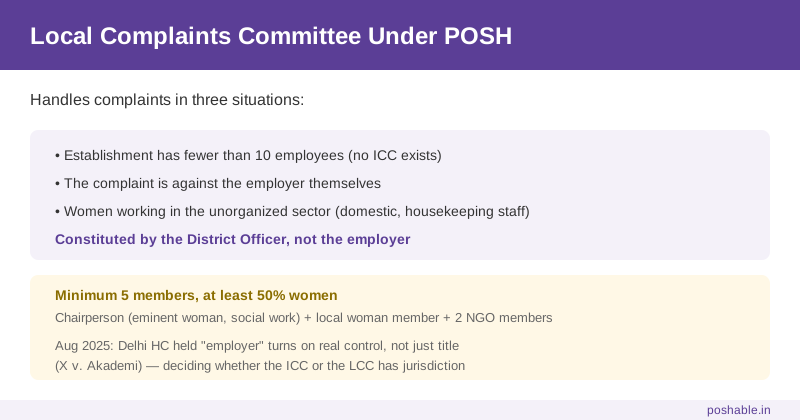
Under Section 6 of the POSH Act, 2013, the Local Committee handles complaints in three specific circumstances: the establishment has fewer than ten employees and therefore has no Internal Committee, the complaint is against the employer themselves, or the woman works in the unorganized sector, such as domestic or housekeeping work.
Who Actually Counts as “The Employer” for LCC Jurisdiction
This question sounds simple until a complaint actually names someone senior. Courts look past formal job titles and ask who genuinely controls hiring, supervision, and termination. Therefore, a Secretary, Director, or senior administrator with real authority can count as the employer, even if a Board or President technically sits above them on paper.
Local Complaints Committee: Who Sits On It
Every Local Committee has at least five members, and at least half must be women. It includes a Chairperson, an eminent woman with a background in social work and a commitment to women’s causes. It also includes one member who works locally within the block, taluka, tehsil, ward, or municipality. The final two members come from NGOs or associations focused on women’s issues, generally including someone with legal knowledge and someone familiar with sexual harassment specifically.
How a Complaint Actually Reaches the LCC
A woman submits her complaint, along with evidence and witness details, to a Nodal Officer designated for her local block, taluka, tehsil, ward, or municipality. The Nodal Officer then forwards it to the district’s Local Committee within seven days. Consequently, she does not need to know the committee’s exact composition or contact details in advance. She simply needs to find her local Nodal Officer or District Officer.
A 2025 Case That Clarified Who Counts as the Employer
In X v. Akademi and Ors. (Delhi High Court, August 2025), a woman alleged harassment by the Secretary of an autonomous institution. The institution argued its Internal Committee should handle the matter, since ultimate authority technically rested with its Board and President.
The Court disagreed. It found the Secretary genuinely controlled day-to-day administration, including the petitioner’s own appointment and leave applications. On that basis, it held he qualified as the “employer” under the Act. As a result, only the Local Committee had jurisdiction. The Internal Committee structurally could not hear the case at all, regardless of what the institution preferred.
What the LCC Can Actually Do, Including Interim Relief
A Local Committee has the same core powers an Internal Committee has: it can inquire into the complaint, and it can recommend interim relief while that inquiry is pending. In the Akademi case itself, the Local Committee granted the petitioner three months of paid leave well before the High Court proceedings even began. This protection is not just theoretical.
Local Complaints Committee vs Internal Committee: Getting the Forum Right
Sending a complaint to the wrong forum does not just cause delay. An Internal Committee that proceeds despite lacking jurisdiction risks having its entire process set aside later. Therefore, identifying the correct forum at the outset protects the complainant’s case as much as it protects the process itself.
Practical Checklist for Employees Considering the LCC Route
- Confirm whether your workplace has fewer than ten employees, meaning no Internal Committee should exist
- Ask directly whether the person you are complaining about holds real administrative control, not just a senior title
- Locate your area’s Nodal Officer through the District Officer’s office if you are unsure where to file
- Keep six copies of your complaint and supporting evidence ready, as most Local Committees require this
What This Means for Employers Too
Employers should not assume every complaint automatically belongs with their own Internal Committee. Where a complaint names someone with genuine executive authority, redirecting it to the Local Committee immediately protects the organization. Failing to do that is exactly the jurisdictional challenge Akademi faced.
Request a demo today to see how our POSH compliance solutions can help your organization stay compliant and build a safer workplace.
POSH Compliance Services for Getting Jurisdiction Right
Many organizations bring in POSH compliance services specifically to build clear internal guidance on when a complaint should go to the Local Committee instead of the internal process. This sits alongside the employer’s broader Section 19 duties, since routing a complaint correctly is itself part of taking the process seriously.
Conclusion: The Local Complaints Committee Is Not a Backup Option
In conclusion, the Local Complaints Committee exists for real, specific situations an Internal Committee structurally cannot handle: small workplaces, unorganized-sector work, and complaints against the employer directly. Moreover, as the Akademi case shows, courts are willing to look past formal titles to determine which forum genuinely has jurisdiction. Therefore, both employees and employers benefit from understanding this second forum, not just the one inside their own office.
Request a demo today and discover how our expert-led POSH compliance services can help your organization stay compliant, reduce risk, and build a safer workplace.