
Most POSH policies mention confidentiality in a single line. However, Section 16 of the Act is far more specific than most people realize, and getting it wrong carries a real penalty. Therefore, understanding exactly what POSH confidentiality covers, and where its limits actually sit, matters for everyone involved in a case.
Moreover, confidentiality here is not just good practice. It is a statutory obligation that overrides even the Right to Information Act. As a result, IC members, HR teams, and witnesses all carry a legal duty most of them have never read in full.
Request a demo today to see how our POSH compliance solutions can help your organization stay compliant and build a safer workplace.
What You’ll Learn in This Guide
This article covers:
- What Section 16 actually prohibits, word for word
- The narrow proviso everyone tends to misread
- Who this obligation binds, and who it does not
- A landmark Bombay High Court order on confidentiality
- Penalties for getting this wrong
POSH Confidentiality: What Section 16 Actually Prohibits
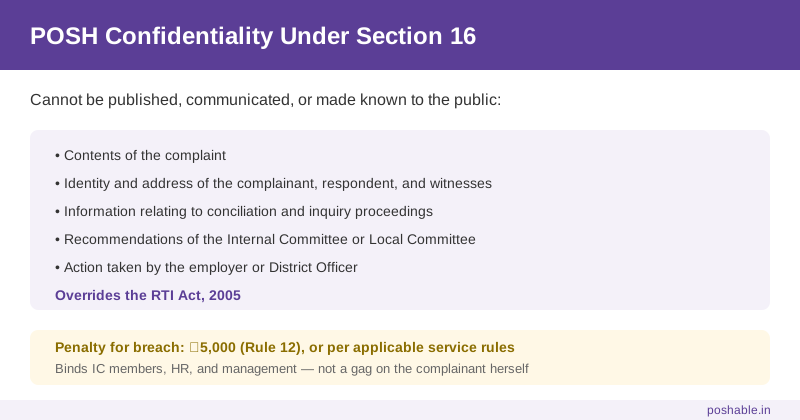
Under Section 16 of the POSH Act, 2013, nobody may publish, communicate, or make known to the public, press, or media:
- The contents of the complaint itself
- The identity and address of the complainant, respondent, and witnesses
- Any information relating to conciliation or inquiry proceedings
- The Internal Committee’s or Local Committee’s recommendations
- The action the employer or District Officer actually takes
This provision applies notwithstanding the Right to Information Act, 2005. Therefore, an RTI request cannot force disclosure of any of this material, even from a public sector employer.
The Proviso Everyone Misreads: What Can Actually Be Disclosed
Section 16 does carry one exception. An organization may disseminate information about “justice secured” to a victim, but only without disclosing her name, address, or any detail that could identify her or the witnesses.
However, this proviso is narrower than most people assume. It only covers cases where the complaint succeeded. Consequently, quietly publicizing that “action was taken” in a case that was dismissed sits outside what the proviso actually permits.
Who This Obligation Actually Binds
Confidentiality binds Internal Committee members, HR, management, and anyone else entrusted with handling the complaint, inquiry, recommendations, or resulting action. Witnesses typically sign a separate non-disclosure undertaking as well.
Moreover, this duty does not gag the complainant herself. She remains free to speak to her own lawyer, her doctor, the National Commission for Women, or through the government’s SHe-Box portal, all in confidence. Section 16 protects her; it was never designed to silence her.
Confidentiality and the Right to Information Act
Public sector employers sometimes face RTI requests demanding IC records. However, Section 16 explicitly overrides the RTI Act for this specific category of information. Therefore, employers can and should decline such requests, citing Section 16 directly rather than treating the request as a gray area.
Penalties for Breaching POSH Confidentiality
Anyone who contravenes Section 16 faces a penalty under their applicable service rules, or where none exist, a monetary penalty of up to ₹5,000 under Rule 12 of the POSH Rules. Moreover, Rule 14 separately requires that Internal Committee records and recommendations stay confidential, except where disclosure is required by law or a competent court’s order.
Where Natural Justice Limits This Protection
Confidentiality is not absolute secrecy from the parties themselves. A respondent facing disciplinary action is still entitled to the material he needs to mount a defense. In one recent Kerala High Court matter, the Court confirmed that providing an employee copies of relevant inquiry documents for his own disciplinary proceedings does not amount to “publication” under Section 16 at all, since that prohibition targets disclosure to the public, press, or media, not to the parties involved.
Consequently, committees should not hide behind confidentiality to deny a respondent the basic information natural justice requires him to have.
A Landmark Case: How Courts Actually Protect Identities
In P v. A & Ors. (2021), Justice G.S. Patel of the Bombay High Court issued a first-of-its-kind protocol specifically to protect identities in POSH litigation. The guidelines direct courts to anonymize both parties in every order, using labels like “A” and “B” rather than real names, and to conduct hearings in a manner that shields identities from even accidental disclosure.
Moreover, the Court made clear that this protection runs both ways. It covers the respondent just as much as the complainant, and any breach, whether by a party, a witness, or even legal counsel, amounts to contempt of court. This remains one of the clearest judicial statements on how seriously Indian courts take POSH confidentiality once a matter reaches litigation.
POSH Confidentiality Does Not Gag the Complainant Herself
This point is worth repeating because it gets misunderstood so often. Section 16 restrains committees, employers, and third parties from publicizing a case. It was never meant to trap the complainant in silence about her own experience.
Documentation Checklist for Handling Confidential Records
Organizations should maintain:
- Signed non-disclosure undertakings from every IC member and witness
- Case files labeled by initials or codes rather than full names, wherever practical
- Records stored separately, with access limited strictly to those handling the matter
- A clear log of any disclosure made under the “justice secured” proviso
Moreover, this is exactly the kind of control a POSH audit checks for, since loose recordkeeping is often where confidentiality breaches actually begin.
Common Mistakes Companies Make with POSH Confidentiality
- Announcing outcomes company-wide “for transparency,” well beyond what the proviso permits
- Forgetting witnesses need NDAs too, not just the parties themselves
- Treating disciplinary disclosure to the respondent as forbidden, when natural justice actually requires it
- Referencing a past complaint in a background check for a departing or former employee
Request a demo today to see how our POSH compliance solutions can help your organization stay compliant and build a safer workplace.
POSH Compliance Services for Committee Training
Many organizations bring in POSH compliance services specifically to train committees on where confidentiality actually starts and stops. A committee that understands this line protects both the complainant’s privacy and the respondent’s right to a fair hearing, which is exactly the balance a well-run inquiry depends on.
Conclusion: POSH Confidentiality Protects People, Not Secrets
In conclusion, POSH confidentiality exists to protect the people involved in a case, not to bury the process in unnecessary secrecy. Moreover, as the Bombay High Court’s guidelines show, Indian courts take this obligation seriously enough to treat careless breaches as contempt. Therefore, every organization should train its committee on both halves of this rule: what must stay private, and what a respondent is still entitled to know.
Request a demo today and discover how our expert-led POSH compliance services can help your organization stay compliant, reduce risk, and build a safer workplace.