
Most employees who file a POSH complaint do not know they can ask for protection before the inquiry ends. Therefore, they simply wait, sometimes sitting across the aisle from the very person they have accused for weeks or months. However, the law already gives them a faster option: POSH interim relief under Section 12.
Moreover, Internal Committees themselves often forget this provision exists, since most POSH training focuses heavily on the inquiry process and skips the protective measures available while that inquiry runs. Consequently, complainants go without transfers, leave, or other safeguards simply because nobody told them to ask. Therefore, both employees and committees need a clear, practical understanding of what Section 12 actually offers.
Request a demo today to see how our POSH compliance solutions can help your organization stay compliant and build a safer workplace.
What You’ll Learn in This Guide
This article covers:
- What POSH interim relief actually includes under Section 12
- How transfer and leave work as protective measures
- Why a written request matters and who can make one
- What courts have said about interim relief in practice
- Documentation committees should keep for every request
POSH Interim Relief: Why Employees Often Don’t Ask For It
Many complainants assume they must simply endure the situation until the Internal Committee finishes its inquiry. However, the law does not require this. Section 12 lets the IC step in early, precisely because a 90-day inquiry window can feel unbearable without any protection in the meantime.
POSH Act Section 12: What This Protection Actually Covers
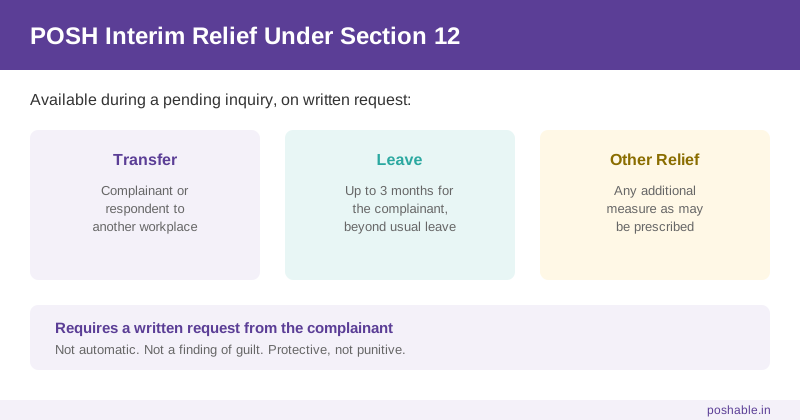
Under Section 12 of the POSH Act, 2013, the Internal Committee or Local Committee may recommend that the employer take one or more of the following steps during the pendency of an inquiry:
- Transfer the complainant or the respondent to another workplace
- Grant the complainant leave of up to three months, in addition to her regular leave entitlement
- Grant any other relief the applicable rules prescribe
Moreover, the employer must actually implement whatever the committee recommends here — this is not a mere suggestion the employer can weigh and set aside.
Transfer as Interim Relief: Protecting the Complainant, Not Punishing the Respondent
Committees can transfer either party — the complainant or the respondent — depending on what will actually reduce contact and risk. Therefore, transferring the respondent often serves the complainant better, since it avoids disrupting her role, team, or reporting line while the inquiry continues.
However, employers sometimes hesitate to transfer a respondent, worried it will look like a premature verdict. Courts disagree with that hesitation entirely.
Leave as Protection: The Three-Month Rule
The complainant can request up to three months of leave specifically to recover from the incident or prepare for the inquiry. Importantly, this leave sits on top of whatever leave she already has — the committee cannot count it against her existing balance.
Moreover, courts have shown real flexibility here. In one 2025 Gujarat High Court matter, a judge granted a complainant additional leave even after the inquiry had technically concluded. She still had to sit near the accused at work. The underlying purpose — safety and dignity — matters more than a rigid reading of the timeline.
POSH Interim Relief Requires a Written Request — It Is Not Automatic
Committees cannot grant interim relief on their own initiative. The complainant must submit a written request first. Therefore, ICs should proactively tell every complainant, at the very start of the process, that this option exists — silence here simply means many women never learn they could have asked.
What Courts Have Said About Interim Relief
In Saikuttan O.N. v. Kerala State Electricity Board (2020), a respondent challenged his own transfer, arguing it amounted to retaliation. The Kerala High Court disagreed and upheld the transfer. It held that a transfer carried out consistently with Section 12 does not amount to mala fide action, and courts should not interfere with it.
Consequently, this case gives employers real confidence. Acting on an IC’s Section 12 recommendation, even against a respondent, stands on solid legal ground rather than exposing the organization to a retaliation claim.
POSH Interim Relief and the Presumption of Innocence
Granting interim relief does not decide the underlying complaint one way or the other. The IC has not found anyone guilty simply by recommending a transfer or leave — these measures exist purely to keep the workplace safe while the actual inquiry runs its course.
Therefore, committees should communicate this distinction clearly to both parties, since respondents sometimes wrongly treat a transfer as a punishment rather than a neutral safeguard.
Documentation Checklist for These Requests
Every interim relief request needs a clear paper trail. Committees should keep:
- The complainant’s original written request
- The committee’s written recommendation to the employer
- Proof that the employer actually implemented the recommendation
- A note confirming the leave granted falls outside the complainant’s normal entitlement
Moreover, this record matters just as much once the inquiry itself moves forward. A well-documented interim relief history strengthens the credibility of the entire process. It is also exactly the kind of paper trail a POSH audit checks for.
Common Mistakes Committees Make With These Requests
- Never mentioning Section 12 to the complainant, so she never thinks to ask
- Treating a respondent’s transfer as an admission of guilt rather than a neutral safeguard
- Counting interim leave against the complainant’s regular balance instead of granting it separately
- Skipping documentation because the relief feels informal or temporary
Request a demo today to see how our POSH compliance solutions can help your organization stay compliant and build a safer workplace.
POSH Compliance Services for Committee Training
Many organizations bring in POSH compliance services specifically to train committee members on provisions like interim relief, which generic training often glosses over. Moreover, well-trained committees apply Section 12 confidently instead of hesitating at exactly the moment complainants need protection most. This mirrors what a properly formed Internal Committee already gets right.
Conclusion: POSH Interim Relief Is a Right, Not a Favor
In conclusion, POSH interim relief exists precisely so complainants do not have to wait out a stressful inquiry unprotected. Moreover, courts have consistently backed committees that use Section 12 as intended, which gives employers a strong incentive to apply it confidently rather than cautiously. Therefore, every IC should treat informing complainants about interim relief as a standard first step, not an afterthought.
Request a demo today and discover how our expert-led POSH compliance services can help your organization stay compliant, reduce risk, and build a safer workplace.