
Does POSH protect men? This question comes up in nearly every POSH training session, usually from someone who assumes the answer is yes. It is a reasonable assumption. The Act protects people from harassment, so surely it protects everyone. However, the actual answer is more specific than that, and it has stayed that way even after a direct Supreme Court challenge.
Moreover, understanding exactly who the POSH Act covers, and who it does not, matters for both employees trying to find the right remedy and employers deciding how far their own policies should go.
Request a demo today to see how our POSH compliance solutions can help your organization stay compliant and build a safer workplace.
What You’ll Learn in This Guide
This article covers:
- The short, direct answer to whether POSH covers men
- Why the Act defines “aggrieved woman” the way it does
- Which parts of POSH actually are gender-neutral
- What the Supreme Court decided in 2023
- What a man can actually do if he faces harassment at work
Does the POSH Act Protect Men? The Short Answer
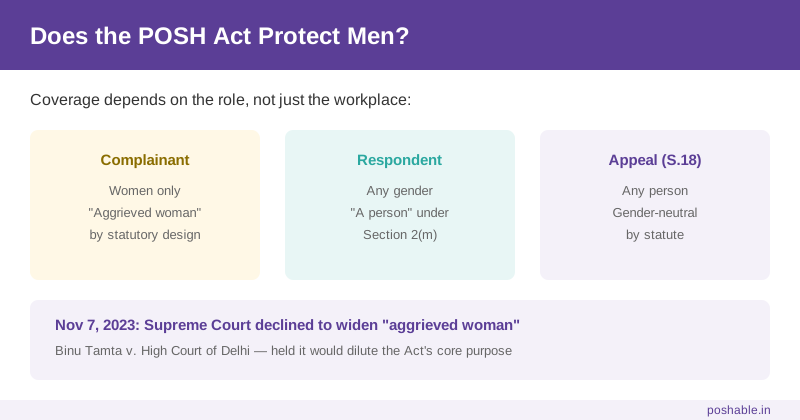
No. The POSH Act, 2013 defines a complainant specifically as an “aggrieved woman.” A man cannot file a complaint with an Internal Committee as the person harassed, no matter how serious the conduct.
Why “Aggrieved Woman” Is Defined the Way It Is
This is not an oversight. The Act traces directly back to the Vishaka Guidelines, born from the case of Bhanwari Devi, and drew its authority from Article 15(3) of the Constitution, which specifically permits special provisions for women. Therefore, the gender-specific scope was a deliberate legislative choice, not a gap nobody noticed.
The Parts of POSH That Actually Are Gender-Neutral
Interestingly, not every part of the Act is women-only. The Act defines a respondent, meaning the person accused, simply as “a person,” which covers any gender. Similarly, Section 18 allows “any person” to file an appeal against an Internal Committee’s decision. Consequently, a committee can absolutely find that a man violated POSH, and a man can appeal a decision under it. He just cannot be the original complainant.
Does POSH Act Protect Men: What the Supreme Court Said in 2023
This is not just a theoretical question. In Binu Tamta v. High Court of Delhi (November 7, 2023), a petitioner asked the Supreme Court to make its own internal sexual harassment regulations, modelled on POSH, gender-neutral. The Court refused, holding that broadening the definition would dilute the regulation’s core purpose of protecting women.
Notably, the Court acknowledged the gap this leaves. It recognized that an LGBTQIA+ person facing similar harassment would have no equivalent remedy under these specific regulations, but held that fixing this required new legislation, not a judicial rewrite of an existing one.
What About Transgender and LGBTQIA+ Employees?
POSH does not extend to transgender employees either. However, they are not entirely without a remedy. The Transgender Persons (Protection of Rights) Act, 2019 requires organizations to appoint a Complaints Officer to handle harassment and discrimination complaints from transgender employees, operating as a separate mechanism alongside POSH rather than through it.
So What Can a Man Actually Do If He’s Harassed at Work?
A man facing workplace harassment currently has to rely on general remedies rather than a dedicated statutory channel. This can include the company’s own internal grievance policy, general disciplinary action under service rules, or criminal remedies under the applicable law where the conduct rises to that level. Therefore, the practical outcome depends heavily on what the specific employer has chosen to build beyond the statutory minimum.
Why Some Companies Go Further Than the Law Requires
A number of large Indian employers have voluntarily adopted gender-neutral anti-harassment policies that sit alongside their statutory POSH obligations. This does not replace POSH compliance for women, since that remains a separate legal requirement. Rather, it extends similar protection and process to employees POSH itself does not reach.
Does POSH Act Protect Men: Common Misconceptions
- Assuming any harassment claim automatically falls under POSH, regardless of who is complaining
- Believing a man cannot be disciplined under POSH, when respondents can be any gender
- Thinking the Supreme Court simply overlooked this issue, when it directly addressed and declined to change it in 2023
- Assuming no remedy exists at all for men, when general grievance and disciplinary routes usually still apply
Practical Checklist for Employers Building Broader Protection
- Keep statutory POSH compliance fully intact for women, since that obligation does not change
- Decide deliberately whether to extend an equivalent process to men and other genders
- Make sure any internal committee handling broader complaints has a clearly defined mandate
- Update the written policy so employees know exactly which mechanism applies to their situation
Request a demo today to see how our POSH compliance solutions can help your organization stay compliant and build a safer workplace.
POSH Compliance Services for Comprehensive Workplace Policies
Many organizations bring in POSH compliance services to build this exact kind of layered protection: full statutory compliance for women, plus a deliberate, well-documented policy for everyone else. This matters because an employer’s broader duties toward a genuinely safe workplace do not stop at the statutory minimum.
Conclusion: Does POSH Act Protect Men? Not Yet, But the Conversation Is Growing
In conclusion, the POSH Act does not currently protect men as complainants, and the Supreme Court confirmed as recently as November 2023 that this is a deliberate legislative choice, not an oversight the courts are waiting to correct. Moreover, the parts of the Act that are gender-neutral, respondent status and the right to appeal, show the framework is not entirely one-sided either. Therefore, employers who want broader protection need to build it themselves, on top of, not instead of, full POSH compliance.
Request a demo today and discover how our expert-led POSH compliance services can help your organization stay compliant, reduce risk, and build a safer workplace.