
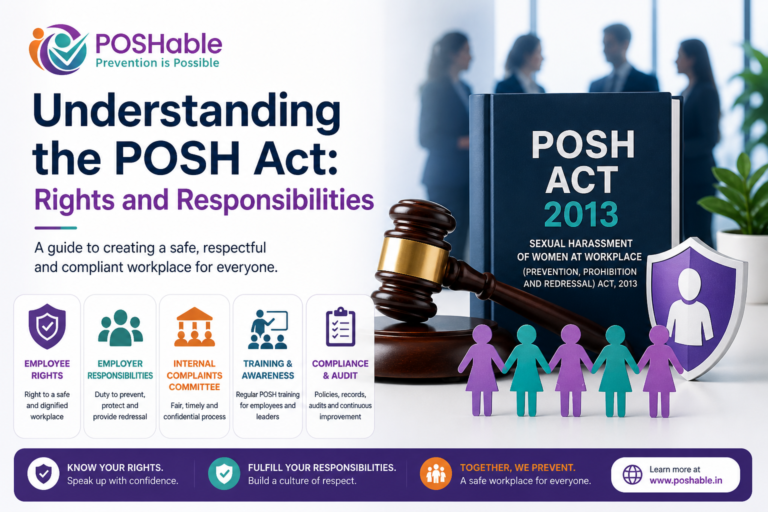
Understanding POSH Act rights and responsibilities is essential for every organization in India. Companies must follow a structured POSH compliance checklist to meet POSH compliance India standards and ensure proper implementation of the Sexual Harassment of Women at Workplace (Prevention, Prohibition and Redressal) Act, 2013.
Moreover, when businesses clearly understand both employee rights and employer duties, they create safer workplaces. However, many organizations still struggle with workplace harassment compliance due to lack of awareness and training. Therefore, combining POSH training for employees with a strong POSH compliance solution is critical.
Request a demo today to see how our POSH compliance solutions can help your organization stay compliant and build a safer workplace.
In This Guide
- Understanding POSH Act rights and responsibilities
- Employee rights and employer duties
- Role of Internal Complaints Committee
- POSH training and audit checklist
- Workplace harassment compliance best practices
Explore our POSH compliance services to see how we help organizations stay compliant and audit-ready
What Are POSH Act Rights and Responsibilities?
POSH Act rights and responsibilities define how organizations must prevent and address workplace harassment.
Employees are protected under the law, while employers are responsible for creating a safe environment. As a result, both prevention and complaint handling are equally important.
Employee Rights Under POSH Act Rights and Responsibilities
Employees have strong protections under POSH Act rights and responsibilities. Therefore, companies must ensure these rights are clearly communicated.
Employees have the right to
- A safe and respectful workplace
- File complaints without fear
- Confidential handling of complaints
- Fair and unbiased investigation
Moreover, awareness of these rights improves reporting and trust within the organization.
Employer Duties Under POSH Act Rights and Responsibilities in POSH Compliance India
Employers play a key role in ensuring POSH compliance India. Therefore, their responsibilities must be taken seriously.
Employers must:
- Create and implement a POSH policy
- Conduct regular training sessions
- Maintain proper records
- Support investigations
In addition, employers should review systems regularly to improve workplace harassment compliance.
Internal Complaints Committee Role in Rights and Responsibilities
Organizations must establish an
Internal Complaints Committee to handle complaints effectively.
The ICC should include:
- A senior female Presiding Officer
- Employee members
- An external expert
However, proper training is essential. Therefore, many companies seek support from a POSH consultant India.
POSH Training for Employees on Rights and Responsibilities
POSH training for employees is a critical part of POSH Act rights and responsibilities.
Training should include:
- Workplace behavior guidelines
- Reporting processes
- Case scenarios
Today, organizations prefer online POSH training India because it is flexible and scalable. As a result, training becomes consistent across teams.
For HR practices, refer to SHRM
POSH Audit Checklist for POSH Act Compliance
A structured POSH audit checklist ensures compliance readiness.
Organizations must maintain:
- Complaint records
- Training data
- ICC meeting reports
Moreover, regular audits help identify gaps early. Therefore, companies can take corrective action quickly.
Workplace Harassment Compliance and POSH Act Rights and Responsibilities
Strong workplace harassment compliance requires a clear system.
Best practices include:
- Easy reporting channels
- Timely complaint resolution
- Confidential handling
Consequently, employees trust the system and organizations reduce risks.
For official guidelines, visit Ministry of Women and Child Development.
Common Mistakes in POSH Rights and Responsibilities Implementation
Many organizations make mistakes such as:
- Lack of training
- Poor documentation
- No audit process
However, these can be avoided with structured systems and expert-led POSH compliance services.
Why POSH Compliance Services Support POSH Act Rights and Responsibilities
Managing compliance can be complex. Therefore, companies often work with a POSH consultant India.
Experts help with:
- Policy creation
- Training programs
- Audit readiness
- End-to-end POSH compliance solution
As a result, organizations improve efficiency and reduce compliance risks.
Conclusion:
In conclusion, understanding rights and responsibilities is essential for workplace safety. Moreover, companies that invest in POSH training for employees, structured policies, and reliable POSH compliance services achieve better results.
Therefore, organizations must adopt a proactive approach to compliance. As a result, they build trust, reduce risk, and ensure long-term success.
Request a demo today and discover how our expert-led POSH compliance services can help your organization stay compliant, reduce risk, and build a safer workplace.